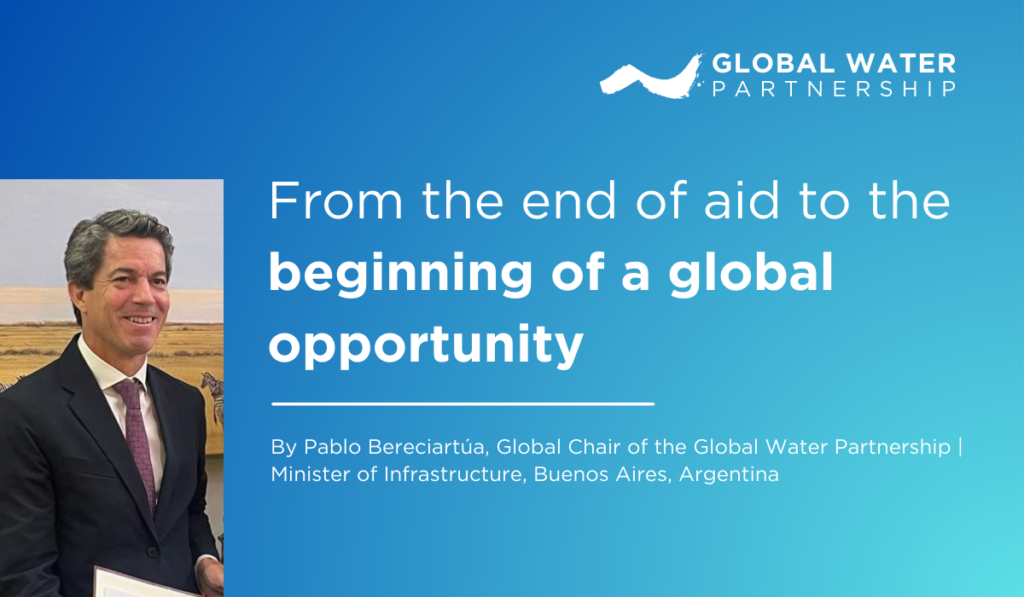
By Pablo Bereciartúa, Global Chair of the Global Water Partnership, Minister of Infrastructure, Buenos Aires, Argentina
Water has become a strategic factor for the global economy, food production, the energy transition and the digital revolution. In a world marked by climate change, the challenge is no longer confined to the Global South, but affects all economies.
Every year, the world invests trillions of dollars in energy, transport, housing and digital technology. Yet, according to estimates by the World Bank and the OECD, the global investment gap in water and sanitation exceeds USD 300 billion per year. In an era of climate change, the energy transition and the rapid acceleration of artificial intelligence, this gap is no longer merely an environmental or social concern: it is a global economic risk.
Water is more than ever a strategic input to the global economy: without water, there is no food production, no reliable energy and no digital infrastructure. Prolonged droughts, extreme floods and water stress are affecting agricultural yields, international prices and supply chains, with direct impacts on inflation, social stability and food security on all continents. At the same time, data centres that sustain the digital economy and artificial intelligence depend on large volumes of water for their operation and cooling.
For decades, we have tried to respond to these challenges with a model of international cooperation designed for another time: fragmented aid, sectoral projects and decisions disconnected from the real economy. Today, that model is being left behind. Not as a failure, but as a stage that has passed.
And this opens up an enormous opportunity.
The water challenge can no longer be framed in geographic terms. It affects advanced and developing economies, rural and urban areas, food producers, energy systems and digital platforms alike. For this reason, traditional water governance, although still necessary, is no longer sufficient.
To have real impact, water management must be integrated with new agendas: climate, energy, public finance, territorial planning and technology. The countries and cities that are advancing are those that connect water policy with their macroeconomic and productive strategy. Governance in the 21st century does not only manage resources: it orchestrates complex systems.
In line with this vision, the Global Water Partnership decided to relocate its headquarters to the Global South, not to concentrate the challenge there, but to be closer to regions where the scale of the challenge demands faster innovation. The solutions that emerge in Africa, Latin America or Asia are not local: they are global and transferable.
2026 marks a turning point for the multilateral agenda. Reform of the multilateral development banks, the acceleration of climate finance and the redefinition of international cooperation are unfolding in a world where water is becoming increasingly strategic for the global economy.
It is also a turning point for the Global Water Partnership. After nearly three decades of work in water governance, we are entering a new stage: moving from diagnosis to scale, from sectoral management to economic integration, from technical support to systemic impact.
The old aid model is being left behind. What emerges is a smarter global architecture, equal to the scale of climate change, the energy transition, food security, and the digital revolution.
This is not the end of international cooperation. It is, at last, its adult version.
The original article was published in Spanish.
Del fin de la ayuda al comienzo de una
oportunidad global
Por Pablo Bereciartúa, Chair Global de Global Water Partnership
El agua se ha convertido en un factor estratégico para la economía global, la producción de alimentos, la transición energética y la revolución digital. En un mundo atravesado por el cambio climático, el desafío ya no es solo del Sur Global, sino de todas las economías.
Cada año, el mundo invierte billones de dólares en energía, transporte, vivienda y tecnología digital. Sin embargo, según estimaciones del Banco Mundial y de la OCDE, la brecha global de inversión en agua y saneamiento supera los 300.000 millones de dólares anuales. En un contexto de cambio climático, transición energética y aceleración de la inteligencia artificial, esta brecha ya no es solo un problema ambiental o social: es un riesgo económico global.
El agua, hoy más que nunca, es un insumo estratégico de la economía mundial: sin agua no hay producción de alimentos, no hay energía confiable y tampoco hay infraestructura digital. Las sequías prolongadas, las inundaciones extremas y el estrés hídrico afectan los rendimientos agrícolas, precios internacionales y cadenas de suministro, con impactos directos sobre inflación, estabilidad social y seguridad alimentaria en todos los continentes. A la vez, los centros de datos que sostienen la economía digital y la inteligencia artificial dependen de grandes volúmenes de agua para su operación y refrigeración.
Durante décadas intentamos responder a estos desafíos con un modelo de cooperación internacional diseñado para otro tiempo: ayuda fragmentada, proyectos sectoriales y decisiones desconectadas de la economía real. Hoy ese modelo está quedando atrás. No como un fracaso, sino como una etapa superada.
Y eso abre una oportunidad enorme.
El desafío del agua ya no puede leerse en clave geográfica. Afecta por igual a economías avanzadas y en desarrollo, a zonas rurales y urbanas, a productores de alimentos, sistemas energéticos y plataformas digitales. Por eso, la gobernanza tradicional del agua —aunque sigue siendo necesaria— ya no es suficiente.
Para tener impacto real, la gestión del agua debe integrarse con nuevas agendas: clima, energía, finanzas públicas, planificación territorial y tecnología. Los países y ciudades que avanzan son aquellos que conectan la política hídrica con su estrategia macroeconómica y productiva. La gobernanza del siglo XXI no administra solo recursos: orquesta sistemas complejos.
En coherencia con esta visión, Global Water Partnership decidió trasladar su Headquarters al Sur Global, no para concentrar allí el problema, sino para estar más cerca de regiones donde la escala del desafío obliga a innovar más rápido. Las soluciones que emergen en África, América Latina o Asia no son locales: son globales y transferibles.
El año 2026 marca un punto de inflexión para la agenda multilateral. La reforma de los bancos de desarrollo, la aceleración del financiamiento climático y la redefinición de la cooperación internacional ocurren en un mundo donde el agua se vuelve cada vez más estratégica para la economía global.
También es un punto de inflexión para Global Water Partnership. Después de casi tres décadas trabajando en gobernanza del agua, entramos en una nueva etapa: pasar del diagnóstico a la escala, de la gestión sectorial a la integración económica, del acompañamiento técnico al impacto sistémico.
El viejo modelo de ayuda está quedando atrás. Lo que emerge es una arquitectura global más inteligente, a la altura del cambio climático, de la transición energética, de la seguridad alimentaria y de la revolución digital.
No es el fin de la cooperación internacional. Es, por fin, su versión adulta.