
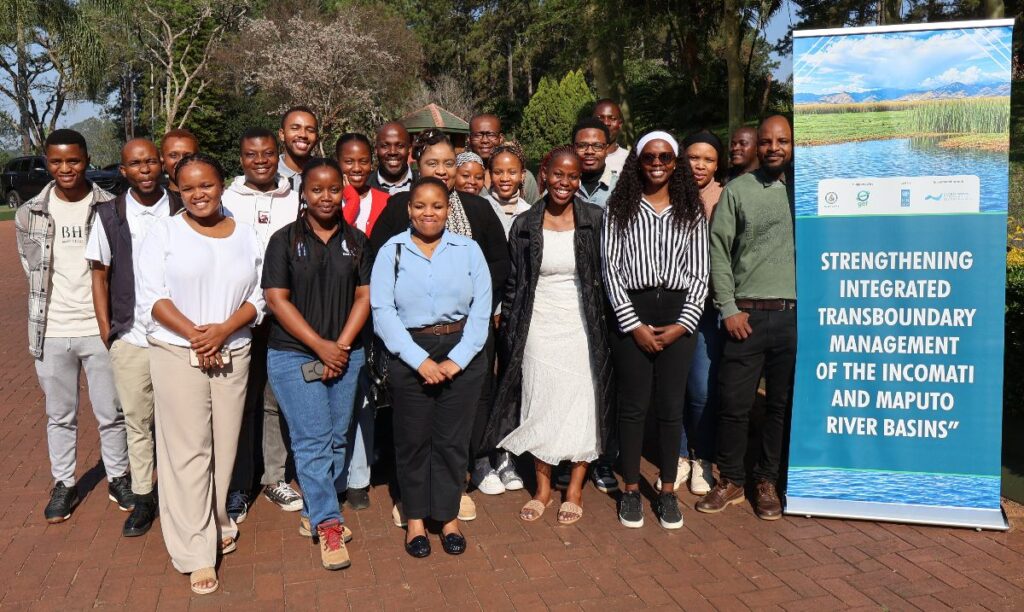
More than 15 young graduates gained practical skills to become the next generation of water stewards through a citizen science training organised by the Incomati and Maputo Watercourse Commission (INMACOM) under the Phophonyane River Watch Initiative.
Held from 6 to 7 July in Eswatini, the training brought together graduates from the University of Eswatini (UNESWA) and members of Eswatini Youth in Water (EYIW), with a focus on equipping young people with practical knowledge and tools to participate meaningfully in water resources management. Supported financially by the German Government through the GIZ Transboundary Water Management Programme, the initiative was organised in collaboration with the Joint River Basin Authorities – Project Board and the Eswatini National Trust Commission.
The training was undertaken under the “UNDP-GEF Project: “Strengthening Integrated Transboundary Management of the Incomati and Maputo River Basins,” one of the projects that INMACOM is implementing. Among others, the project is supporting opportunities that place young people at the centre of water management. The project, under implementation in Eswatini, South Africa and Mozambique, is financed by the Global Environment Facility (GEF), implemented by the United Nations Development Programme (UNDP) and executed by the Global Water Partnership Southern Africa (GWPSA) through INMACOM.
The project is also supporting approaches that strengthen data and information systems, climate and disaster risk preparedness, basin-wide planning and source-to-sea management. Engaging young people in these processes, helps build a generation with the skills and confidence to contribute to evidence-based water management, while creating pathways for youth to become active contributors, not simply beneficiaries of decisions affecting shared water resources.
The training demonstrated how citizen science can help bridge information gaps and strengthen community participation in transboundary water management. Participants explored experiences from the Limpopo Watercourse Commission (LIMCOM), including how citizen generated information can support the identification and communication of pollution incidents and contribute to more responsive water management. They also examined the impacts of climate change across the Incomati–Maputo Watercourse and explored the Source-to-Sea Approach, which recognises the interconnectedness of rivers, ecosystems, communities and economic activities. Through practical exercises, participants learned how aquatic macroinvertebrates can be used as indicators of river health and how agricultural activities can affect freshwater ecosystems.
A key highlight was the introduction of the mini-Stream Assessment Scoring System (miniSASS), a simple, low-cost citizen science tool that enables communities to assess the health of rivers using aquatic macroinvertebrates. The hands-on experience demonstrated how young people can contribute to generating locally relevant environmental information while developing practical skills in water monitoring and stewardship. Initiatives such as this are part of a broader commitment to strengthening inclusive and sustainable water governance by investing in youth capacity, knowledge and participation.