
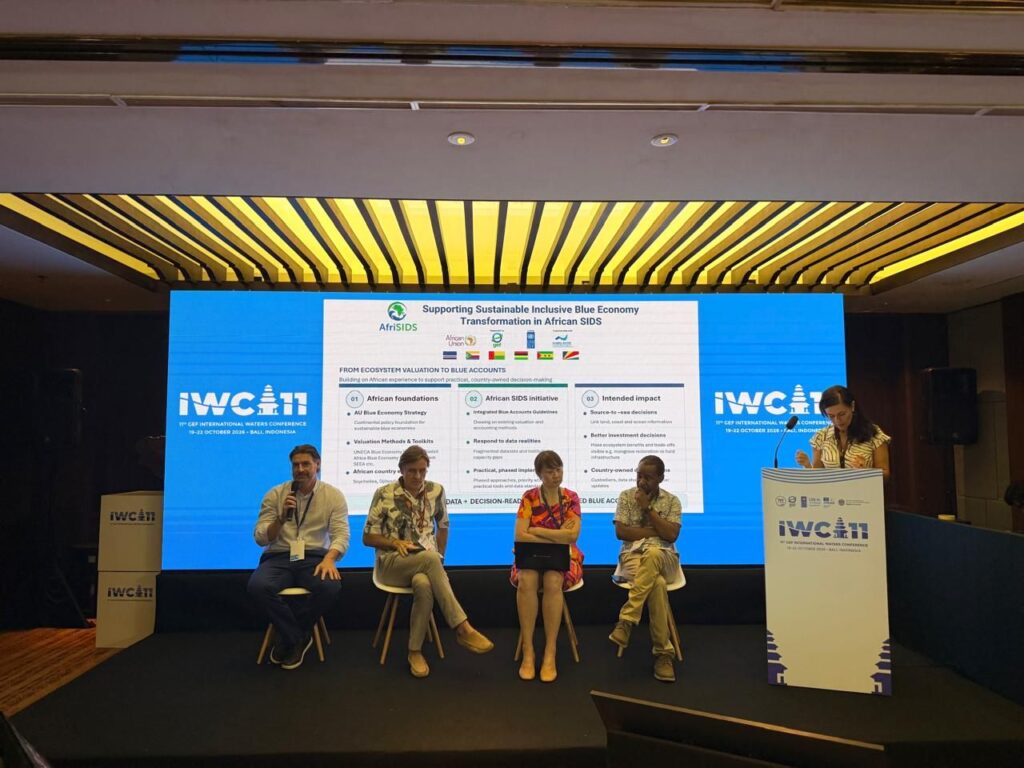
The Supporting Sustainable Inclusive Blue Economy Transformation in African Small Island Developing States (AfriSIDS) Project strengthened its contribution to global discussions on sustainable blue economy development at the 11th Global Environment Facility (GEF) International Waters Conference (IWC11), held in Bali, Indonesia, from 19 – 22 October 2026. Bringing together more than 400 delegates under the theme “Shared Waters, Transformative Solutions: Enabling Systems Change,” the conference provided an opportunity for the project to exchange knowledge, share African experiences and explore approaches to scaling solutions for interconnected freshwater, coastal and marine ecosystems.
During a pre-conference session on Scaling Source-to-Sea Solutions: From National Demonstrations to Regional Transformation, Tsungai Mavambe, Technical Assistant Specialist at the Global Water Partnership Southern Africa (GWPSA), highlighted lessons relevant to AfriSIDS’ work across six African island states: Cabo Verde, Comoros, Guinea-Bissau, Mauritius, Sao Tome and Principe, and Seychelles. He emphasised that scaling successful interventions requires more than replicating pilot activities. “Scaling is not simply about replicating successful pilot projects. It is about creating the conditions that allow those solutions to be adapted, institutionalised and sustained,” Mavambe said. His presentation highlighted the importance of linking national demonstrations with supportive policies, institutional capacity, innovative financing and cross-sectoral coordination to extend their impact beyond individual project sites.
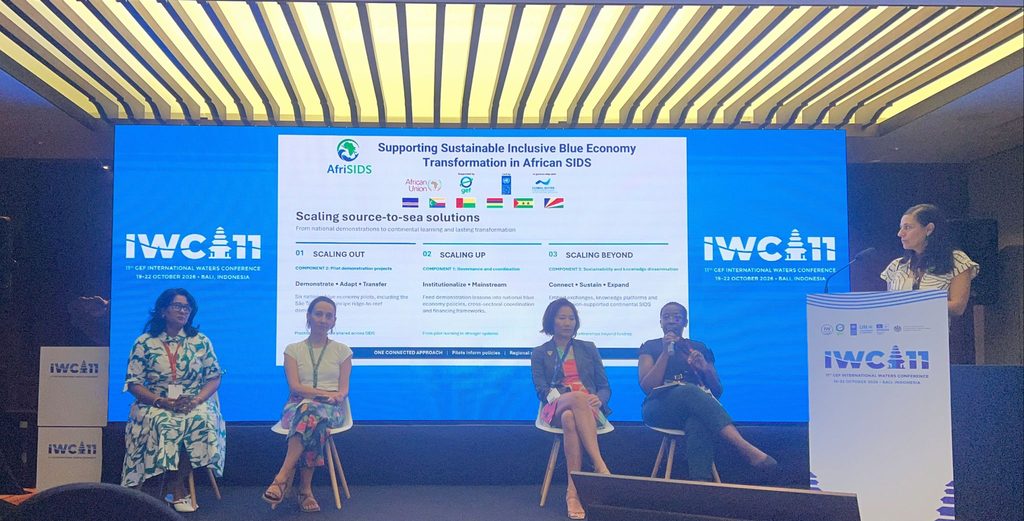
A key lesson for AfriSIDS was the importance of connecting practical demonstrations with national policies, cross-sectoral coordination and long-term investment. The project’s source-to-sea approach recognises the links between land-based activities, freshwater systems, coastal environments and marine ecosystems. In Sao Tome and Principe, for example, a ridge-to-reef demonstration links sustainable agricultural practices and improved management of agricultural inputs with marine spatial planning and conservation. These integrated interventions illustrate how coordinated action across ecosystems can help address environmental degradation while supporting sustainable livelihoods. Mavambe stressed “the real measure of successful scaling is not only whether a solution works in one location, but whether we have created the conditions for it to work elsewhere and to continue delivering benefits long after the original project has ended.”
IWC11 also highlighted the value of inter-regional knowledge exchange in strengthening cooperation among Small Island Developing States (SIDS). Experiences from the Caribbean and Pacific offered AfriSIDS valuable lessons on collaboration, working within small and resource-constrained markets, and the importance of speaking with one voice to advance shared priorities. Although African SIDS are geographically dispersed, they face similar development challenges, creating opportunities to adapt successful approaches across regions. For AfriSIDS, these lessons reinforced the need to strengthen partnerships, document national experiences and improve coordination to advance shared blue economy priorities, mobilise investment and sustain results beyond the project lifecycle.
AfriSIDS’ participation in IWC11 reinforced its commitment to advancing sustainable and inclusive blue economy development through integrated solutions, stronger institutions and regional cooperation. The AfriSIDS Project is funded by the Global Environment Facility (GEF), implemented by the United Nations Development Programme (UNDP), executed by GWPSA, and undertaken in collaboration with the African Union Commission (AUC). Through its work across six African Small Island Developing States, AfriSIDS continues to support national blue economy initiatives and strengthen the frameworks, partnerships and knowledge-sharing mechanisms needed to sustain and scale their impact.