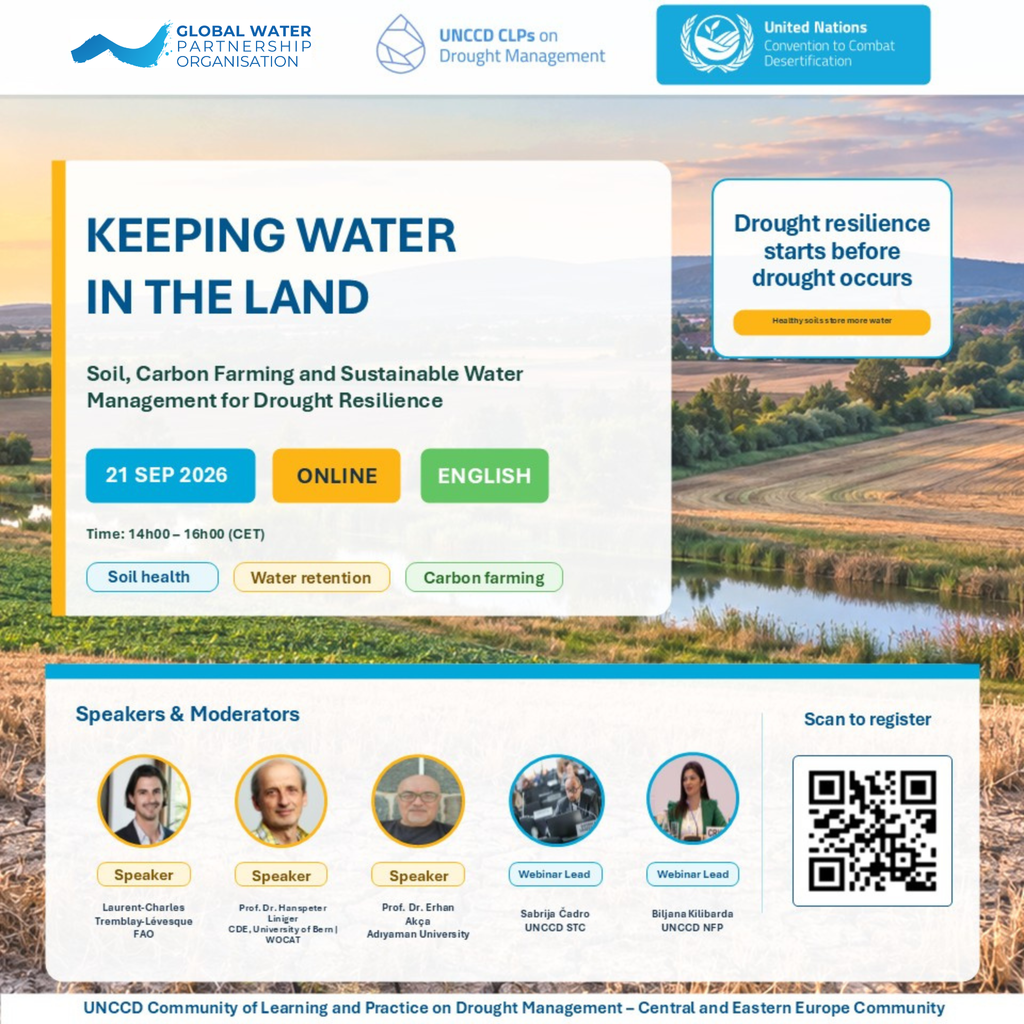
📅 Date: 21 September 2026
🕑 Time: 14:00 CEST (2hr)
✍️ Registration Link: Meeting Registration – Zoom
Drought is increasingly becoming one of the most important climate-related risks for agriculture, land management and rural livelihoods across Central and Eastern Europe and the Mediterranean. However, drought resilience is not determined only by rainfall, irrigation infrastructure or emergency response. It is also strongly shaped by the condition of land and soil before drought occurs.
Soils with better structure, higher organic matter content, continuous cover, improved biological activity and better infiltration capacity can store and retain more water, reduce runoff and erosion, support crops during dry periods and improve the overall resilience of farming systems. This makes sustainable land management, carbon farming and soil-water management highly relevant for drought preparedness and adaptation.
The webinar will focus on practical land-based measures that can improve soil water retention and reduce vulnerability to drought. These include conservation and reduced tillage, mulching, cover crops, crop residue management, organic amendments, compost, manure, biochar, agroforestry, windbreaks, buffer strips, terraces, micro-retention measures, water harvesting, and improved irrigation scheduling.
The session will also connect these practices with the UNCCD Community of Learning and Practice approach, highlighting the role of social learning, regional exchange and available online learning resources. A short policy-oriented discussion will address how these practices are currently supported, whether they are linked to carbon farming incentives or MRV systems, and what is needed to scale them up across the region.
The overall objective of the webinar is to strengthen regional knowledge exchange on practical soil, water and carbon farming practices that improve drought resilience in agricultural landscapes across Central and Eastern Europe and Mediterranean-type regions.
The webinar aims to:
- Present the role of the UNCCD CLP as a platform for social learning, peer exchange and capacity building on drought resilience.
- Explain the link between drought, soil degradation, soil organic carbon, water retention and land resilience.
- Showcase practical sustainable land management and carbon farming measures that help retain water in the soil and reduce drought impacts.
- Discuss the relevance of biochar, organic amendments, agroforestry and sustainable water management for drought-prone farming systems.
- Explore barriers to wider uptake of these practices at national level, including finance, advisory support, incentives, MRV and certification.
- Collect regional feedback from participants on how these practices are applied and supported in their countries.