With sustained political leadership and practical partnerships, Windhoek can become a global hub for water diplomacy and investment
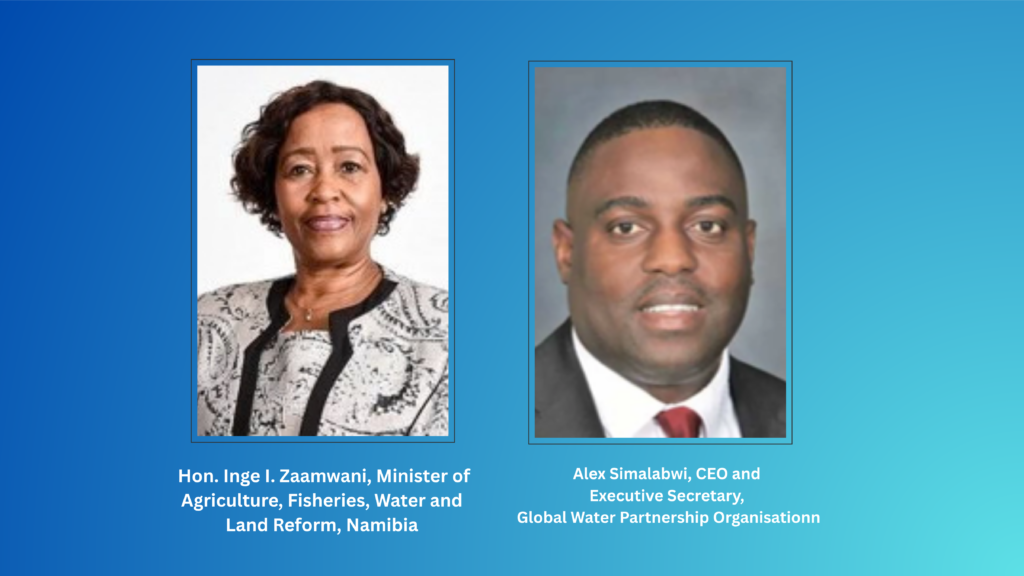
By Hon. Inge I. Zaamwani, Minister of Agriculture, Fisheries, Water and Land Reform, Namibia, and Alex Simalabwi, CEO and Executive Secretary, Global Water Partnership Organisation
For Namibia, a drop of water is an ocean. That is why countries that live with water scarcity can offer some of the clearest leadership on water security. In an arid country, water determines where communities can thrive, how food is produced, whether industries can grow and how the economy withstands climate shocks. Namibia has responded by treating water as a national development priority and, increasingly, as an instrument of regional cooperation and global diplomacy.
That approach matters well beyond Namibia. Public budgets are constrained, climate risks are intensifying and demand for reliable water services continues to rise. Yet too many viable water projects remain caught between political commitment and financial close. Governments identify priorities, but investors often see projects that are not sufficiently prepared or structured. The result is a persistent gap between the finance available in global markets and the infrastructure that countries urgently need.
Namibia is helping to close that gap through political leadership. As a founding Co-Chair of the International High-Level Panel on Water Investments for Africa, alongside Senegal and other distinguished leaders, Namibia has championed the Continental Africa Water Investment Programme (AIP). The AIP seeks to mobilise at least US$30 billion a year by 2030 for water security and sustainable sanitation. Current annual investment is estimated at only US$10–19 billion.
The African Union AIP Water Investment Summit in Cape Town in 2025 demonstrated what becomes possible when political and financial leaders work from the same agenda. Convened under South Africa’s G20 Presidency, the Summit brought together Heads of State, investors, development institutions and private-sector leaders around an estimated US$10–12 billion pipeline of potential water investments. At the Summit, South African President Cyril Ramaphosa launched the Global Outlook Council on Water Investments and the Global Water Investment Platform to carry those outcomes into implementation and extend the approach globally.
Namibia is sustaining that momentum. On 21 September, on the margins of the United Nations General Assembly in New York, President Netumbo Nandi-Ndaitwah will convene a Global Leaders Event with Senegal, the African Union Commission, the High-Level Panel and international partners. Leaders will review the AIP’s progress, consider the AIP Water Investment Scorecard covering more than 30 countries, and mobilise commitments towards the 2026 United Nations Water Conference in Abu Dhabi.
This leadership is consistent with Namibia’s wider record in multilateral affairs. Namibia and Germany co-facilitated the intergovernmental negotiations on the Pact for the Future. The Pact calls for stronger international cooperation, faster implementation of the Sustainable Development Goals and reform of the international financial architecture. Water provides a practical test: can countries obtain the support required to prepare credible projects, mobilise finance and deliver resilient services?
Namibia is also building the national platform from which this international leadership can grow. From 13 to 16 October, the Third Namibia Regional Water Symposium in Swakopmund will focus on ensuring water security through innovation, collaboration and responsible water stewardship. Its programme connects national water-resource challenges with climate vulnerability, rural and municipal supply, groundwater, desalination, water reuse, research, industry, governance and community-based management. The planned site visits to a wastewater treatment facility, a desalination plant and a fishing operation reinforce an important point: solutions must work in practice.
The Global Water Partnership Organisation (GWPO) is proud to support this national effort. Working with the Ministry of Agriculture, Fisheries, Water and Land Reform, GWPO will draw on its technical expertise and global network to connect Namibia’s priorities with relevant experience and solutions. Our cooperation will also support discussion of a national water investment programme, wider public engagement, communications, and stronger participation by young people and students.
The partnership is already expanding the diplomatic constituency for water. In August, Namibia joined South Africa, the World Meteorological Organization and GWPO in launching the Global Ambassadors’ Forum for Water and Economic Diplomacy at World Water Week in Stockholm. Diplomats from nearly 30 countries attended. The Forum will equip ambassadors to raise water on national and international agendas, strengthen cooperation across borders, and connect country-led investment pipelines with development and climate finance.
GWPO’s decision to establish its global headquarters in Windhoek adds institutional capacity to Namibia’s ambition. Windhoek aim to become a hub where political leaders, diplomats, technical experts, financiers and project developers address the barriers that hold projects back. Through GWPO, Namibia can connect its national priorities with a network of more than 2,800 water organisations and with the Global Water Investment Platform.
The next phase must concentrate on execution. Countries need upstream support to prepare projects to the standard expected by public and private financiers. Risk-reduction facilities must help promising projects advance from concept to bankability. Progress must also be measured transparently so leaders can identify bottlenecks and hold institutions accountable. The Global Water Investment Platform and its Upstream De-risking Facility are designed to support this work, while the AIP Scorecard provides a basis for tracking national readiness and delivery.
Namibia brings valuable credibility to this agenda. It understands the discipline of managing limited water resources and the value of innovation, stewardship and cooperation. It also demonstrates why water investment should be treated as productive economic investment. Reliable water systems support agriculture, energy, mining, cities, public health and trade. They protect economies from climate shocks and create the conditions for long-term growth.
The 2026 United Nations Water Conference offers an opportunity to move from declarations to delivery. Governments and partners should arrive in Abu Dhabi with country-owned investment programmes, prepared projects, financing partnerships and measurable commitments. Namibia’s leadership, backed by the African Union, the G20 legacy initiative and partners such as GWPO, can help set that standard. From Swakopmund and Windhoek to New York and Abu Dhabi, Namibia is demonstrating how national experience can become global leadership and how diplomacy can be translated into water security for people.