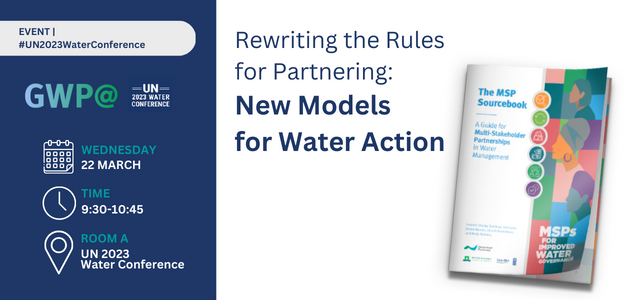
The event will be divided into two parts.
Part 1: The first part of the event will focus on presenting the six ingredients for building effective water partnerships and the practical tools showcased in GWP’s “MSP Sourcebook: A Guide for Water Partnership”.
Ingredient 1 – Context analysis: How to assess water challenges through the lens of MSPs and how MSPs can be analysed and established in a practical manner.
Ingredient 2 – Setting an agenda for change:How to prepare for making change through collective action, from a conceptual level down to hands-on project development.
Ingredient 3 – Knowledge management: How knowledge can be shared and leveraged between multiple organisations within and outside a water MSP.
Ingredient 4 – Resource mobilisation: What are the different partnership-based financing mechanisms and how to resource MSPs in the water sector.
Ingredient 5 – Effective communication: How to foster effective communications within MSPs and how to successfully engage external audiences.
Ingredient 6 – Conflict management: How to negotiate and manage conflicts and how to address common tensions that water MSPs face both internally and externally.
Part 2: The second part of the event will dive into practical cases of partnership-based approaches in different sub-sectors of water management. Four cases will be presented:
SDG 6 IWRM Support Programme:assists governments and stakeholders to evaluate the current status of water resources management in their country, every three years. Doing so in a multi-stakeholder environment adds value not just to the monitoring exercise but also to the identification of action pathways to improve water management. Under the guidance of UNEP, the SDG 6 IWRM Support programme is executed in close collaboration with UNEP-DHI, GWP, as well as UNDP Cap-Net. It is currently implemented across 70+ countries.
Global Water Leadership Programme:An initiative designed to bring together water resources management (WRM) and water, sanitation, and hygiene (WASH) decisionmakers to lead and inspire a united approach to developing climate-resilient water policies and plans. This initiative is active across 10 countries and co-implemented with UNICEF.
AIP Scorecard Partnership: The AIP-PIDA Water Investment Scorecard tracks priority water related investments indicators and assist senior leaders to improve accountability, monitoring, and response to the water investments gaps. The AIP Scorecard serves as a tool to engage with public and private investors on financing water infrastructure that will contribute to development.
Multi-stakeholder Regional Dialogues:MSDs for transboundary water cooperation can help transcend policy-making and management silos derived from the sectoral and spatial organisation of administrative and governance structures. Reflections on the regional dialogue processes conducted in South East Europe, South Asia, and Southern Africa will be presented.
Speakers
Alex Simalabwi–GWPSA Executive Secretary,Head-Africa Coordination Unit, GWP Global Head–Climate Resilience
CholponAitakhunova, Regional Coordinator CAY4W, International Secretariat for Water
Damian Indij–Virtual Campus Coordinator, UNDP Cap-Net
Dr.TjašaGriessler Bulc– Full professor at University of Ljubljana, Chair of GWP CEE
Dr. Yumiko Yasuda – Senior Network and Transboundary Water Cooperation Specialist, GWP
Gareth James Lloyd – Deputy Chief Manager, UNEP-DHI Centre
His Excellency Jakaya Mrisho Kikwete– Fourth president of Tanzania, Africa Coordination Unit Chairman, GWPSA
Klaus Leroch – Advisor Water and Sanitation, Austrian Development Agency
Laurent-Charles Tremblay-Levesque – IWRM and Knowledge Management Specialist, Network Specialist for China and South Asia, GWP
Lesley Pories – Coordinator, Global Water Leadership, GWP
Nchedi Moripe – Chief Director, Global Cooperation and Strategic Partnerships, South Africa Department of Water and Sanitation
Pablo Bereciartua –Chair, Global Water Partnership
Prof. Petra Hellegers– Full professor and Chair of the Water Resources Management Group, WUR.
Tom Williams–Senior Director, Nature Action & Member of the WBCSD Extended Leadership Group, WBCSD
Organising partners:
GWPO (lead)
AUDA-NEPAD
Austria, Austria Development Cooperation
Development Bank of Southern Africa/SADC Water Fund
Global Water Partnership Central and Eastern Europe (GWP CEE)
Global Water Partnership China
Global Water Partnership Southern Africa (GWPSA)
Global Water Partnership Uganda
International Secretariat for Water (ISW)
Malawi, Ministry of Water and Sanitation
Senegal, Ministry of Hydraulics and Sanitation
South Africa, Department of Water and Sanitation
Uganda, Ministry of Water & Environment
UNDP
UNDP-CapNet
UNEP-DHI
UNICEF
Wageningen University and Research (WUR)
World Business Council for Sustainable Development (WBCSD)
Zambia, Department of Water Resources Development