
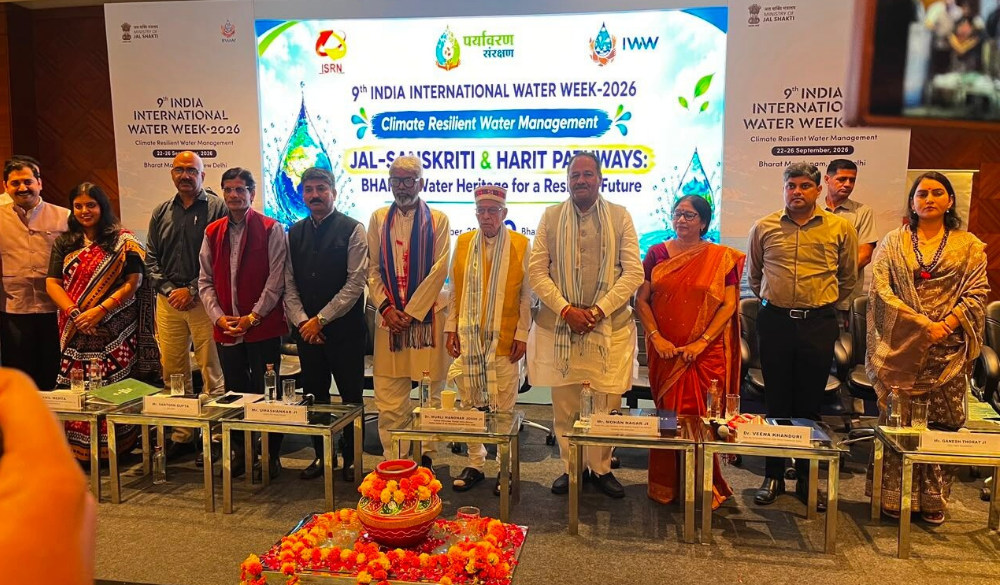
9th India International Water Week (IIWW) was organised by the Department of Water Resources, River Development and Ganga Rejuvenation, Ministry of Jal Shakti, Government of India from 22-26 September 2026 on the theme “Climate Resilient Water Management” in Bharat Mandapam, New Delhi. Making use of this significant platform, India Water Partnership – GWP India (Country Water Partnership of GWP), and partners, made a powerful call to pivot global water policy away from rampant techno-consumerism and back toward indigenous ecological wisdom.
Since 2012, the IIWW has been a returning congress addressing global water challenges, promoting sustainable development, and showcasing innovative solutions. GWP India has played a substantial role for the congress through time – an event which over the years has become a premier platform bringing together policymakers, researchers, industry leaders, and communities from across the globe.
Session highlight: JAL-SANSKRITI & HARIT PATHWAYS: India’s Water Heritage for a Resilient Future
On 24 September, Indian Social Responsible Network (ISRN) and Paryavaran Sanrakshan Gatividhi (PSG), hosted the session “JAL-SANSKRITI & HARIT PATHWAYS: India’s Water Heritage for a Resilient Future,” with several Partners invited as guest speakers, including GWP India, represented by Dr Veena Khanduri, Executive Secretary-cum-Country Coordinator.
The session explored how holistic actions for revitalising Indian traditions can connect India’s rich traditional water wisdom with contemporary science, community action, and policy frameworks, and the message was clear: The fight against climate change in a country like India cannot be won by technology and capital alone. It requires returning to India’s civilisational roots, where water is revered not as a commodity to be exploited, but as a sacred life force to be conserved by the community.
Dr Murli Monahar Joshi, Former Union Minister, Government of India: “Earth came from water”
Delivering the session’s Presidential Address, Dr Murli Monahar Joshi systemically dismantled modern reliance on centralised engineering and unchecked ecological expansion. “Earth came from Water,” Dr Joshi stated, asserting that energy, life, and creation are entirely dependent on hydrological equilibrium.
Dr Joshi highlighted how modern servers and AI infrastructure consume millions of litres of water for cooling and a staggering portion of municipal electricity, effectively draining local resources to export data and capital abroad.
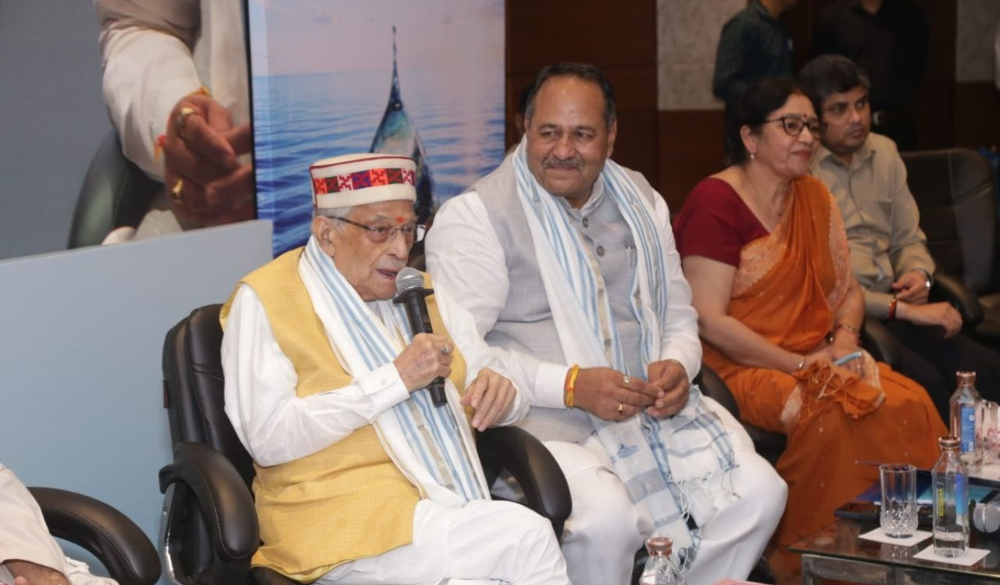
Dr Murli Manohar Joshi, Former Union Minister, Human Resource Development, Science & Technology and Ocean Development, Government of India, delivering the session’s Presidential Address
Dr Veena Khanduri, Executive Secretary-cum-Country Coordinator, GWP-India: A call for the integration of traditional ecological wisdom into modern statutory frameworks
In her speech, Dr Veena Khanduri advocated for the integration of traditional ecological wisdom directly into modern statutory frameworks.
She requested a shift from viewing water primarily as a commodity for consumption and supply to recognising it as a shared natural resource that sustains life, livelihoods, and ecosystems. Calling for integrated approaches, Dr Veena explained how policy can strengthen the linkages between water resources, forests, land, and local communities, through participation by all relevant groups and stakeholders.
As contemporary successful examples of this approach, she brought up the reference of a groundwater management programme, Atal Bhujal Yojana, which used community-led groundwater management and convergence of government schemes in water-stressed areas, and other Government of India initiatives like Mission Life India.
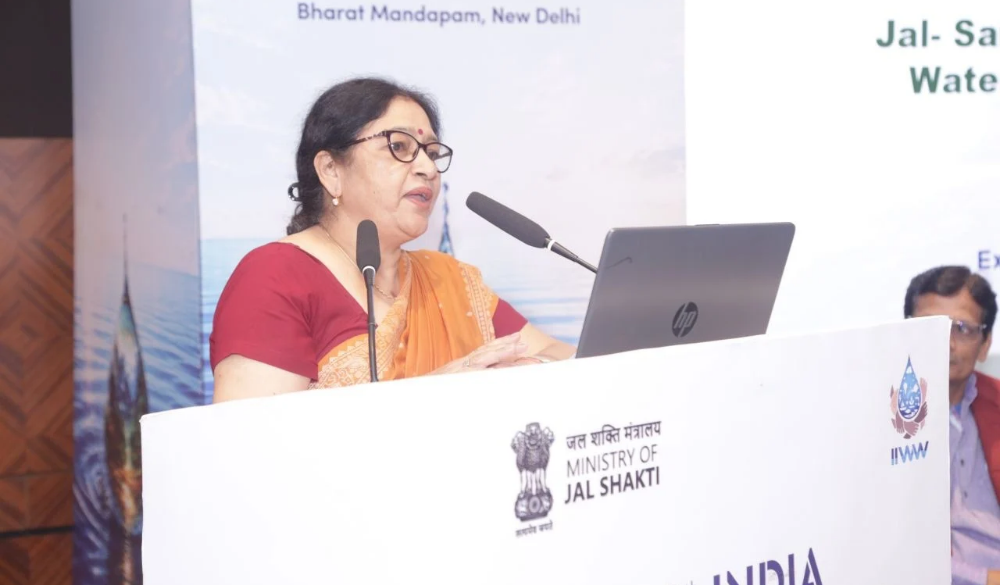
Dr Veena Khanduri, Executive Secretary-cum-Country Coordinator, GWP India delivering her speech
Mr. Mohan Nagar (Madhya Pradesh’s Waterman & Vice-President, Madhya Pradesh Jan Abhiyan Parishad) urged policymakers to “stop the first drop where it falls” rather than building expensive dams as a last resort.
Mr. Umashankar Pandey (Water Warrior, Bundelkhand Region) highlighted the success of the Jakhni model “Khet par med, med par ped” (Fields bounded by Trees).
Mr. Ganesh Thorat (CEO, Naam Foundation) demonstrated a scalable co-financing model where the Foundation provides heavy machinery to desilt dead reservoirs, while local villagers manage operations.
Ms. Shipra Pathak (Water Woman, Founder of Panchtatva) warned against “five-star” pilgrimage tourism that destroys fragile mountain ecologies for the sake of consumer comfort.
Dr. Anil Mehta (Joint Secretary, GWP-India & Chief Editor, Jal Vimarsh) proposed the HARIT framework, urging a shift from Western anthropocentric sustainability—which treats nature merely as an economic component—to the Vedic concept of Rit, which places human society strictly within the bounds of nature.
Mr. Santosh Gupta (CEO, ISRN) delivered the Vote of Thanks and synthesized the deliberations into a definitive five-pillar action plan: Punarjeevan (Revival), Punarsthapana (Restoration), Samanway (Synergy), Sahyog (Collaboration), and Vistar (Expansion).
The session’s overarching message was clear: “From Jal–Sanskriti (Water Culture) to Jal–Sankalp (Water Pledge), and from Heritage to Action.”
The Way Forward is to translate knowledge and dialogue into collective action, community participation, and measurable outcomes. The collective resolve should be to (i) Understand and strengthen our Jal-Sanskriti; (ii) Document and preserve India’s water heritage; (iii) Restore water ecosystems and strengthen ecological resilience; (iv) Integrate traditional wisdom with science, technology, and policy; (v) Promote community-led water stewardship; and (vi) Build partnerships that enable successful approaches to reach wider communities.