
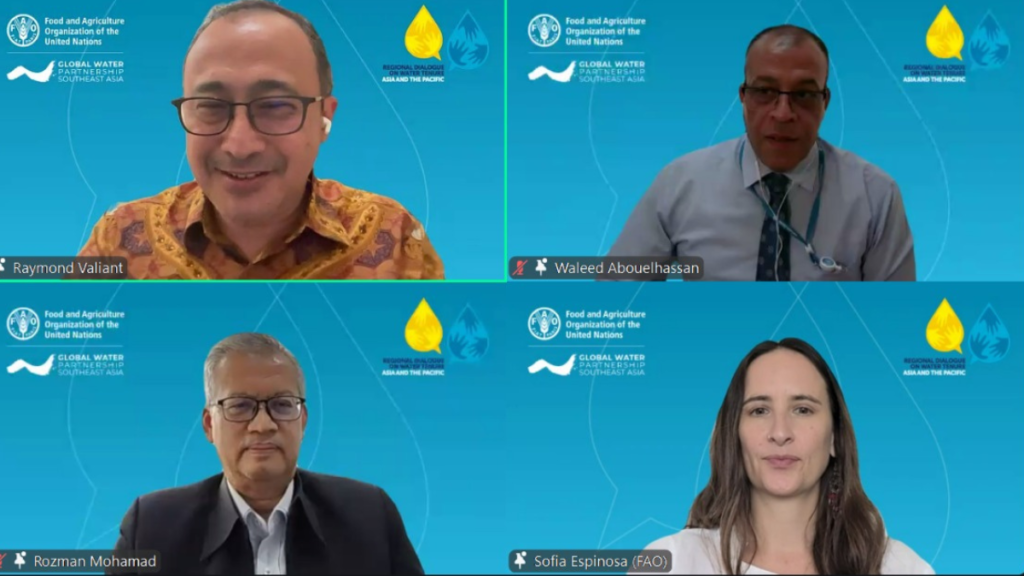
Online, Asia-Pacific Region | 31 March 2026 — The Global Water Partnership Southeast Asia (GWP-SEA) and the Food and Agriculture Organization of the United Nations (FAO) convened the Online Regional Capacity Strengthening: Water Tenure and Assessment Methodology for the Asia-Pacific, bringing together government officials, river basin organizations, civil society representatives, and development partners from across Asia. The two-hour online session marked the formal opening of a broader regional process to strengthen water governance through a clearer understanding of water tenure, who has the right to use water, for what purpose, for how long, and under what conditions.
The session is crucial for the Asia-Pacific region, where climate variability, rapid urbanisation, and competing demands are straining water resources. Many countries have unclear, overlapping, or unevenly enforced rules governing water access, affecting vulnerable groups like smallholder farmers, fishing communities, women, and indigenous groups whose livelihoods depend on secure water access. Dato’ Ir. Rozman Mohamad, Chairperson of GWP-SEA, emphasised the importance of clarifying water tenure to support fair, transparent, and accountable water management.
Dr. Sofia Espinosa of FAO presented the Water Tenure Assessment Methodology, a structured and country-adaptable tool designed to help governments and stakeholders diagnose gaps in their water governance systems across multiple dimensions. Dr. Zelina Zaiton Ibrahim, a member of the GWP-SEA Steering Committee and Coordinating Lead Author of the IPCC Sixth and Seventh Assessment Reports, expanded on the critical linkage between water tenure and Integrated Water Resources Management (IWRM), highlighting that effective multi-sectoral water planning, spanning agriculture, fisheries, the environment, and urban supply.
A panel discussion moderated by Dr. Raymond Valiant of GWP-SEA brought country-level perspectives to the fore. Dr. Karika Kunta, Deputy Dean at Thailand’s National Institute of Development Administration (NIDA), shared insights from Thailand’s national water tenure assessment, illustrating how deeply rooted agricultural customs and formal statutory frameworks do not always align, and why effective governance must acknowledge local realities rather than impose uniform legal solutions. Ms. Diluka Piyasena, Interim Regional Coordinator of GWP South Asia, drew on experience across Bangladesh, Bhutan, India, Nepal, Pakistan, and Sri Lanka to underscore that transboundary river systems require shared governance frameworks, and that water tenure could serve as a common language for building durable regional cooperation.
Water tenure reform must go beyond legal frameworks. Communities in the Asia-Pacific have sustainably managed water resources through customary arrangements for centuries. Any governance approach that ignores these local systems risks undermining trust and repeating past reform failures. As the Deputy Director General of Lao PDR’s Department of Water Resources said, regional exchanges like this offer valuable opportunities to learn, share experiences, and build inclusive, transparent, and sustainable water management.
The 31 March session is the first step in a multi-stage regional process under the GWP-SEA and FAO Regional Roadmap on Water Tenure for Asia and the Pacific. A Pre-Regional Dialogue and a full Regional Dialogue on Water Tenure for Asia and the Pacific are both planned for later in 2026, with FAO’s ScaleWat project available to support countries in undertaking national-level water tenure assessments. Through its regional coordination role, GWP-SEA continues to work with countries across Southeast Asia and the wider Asia-Pacific to advance water governance that is inclusive, evidence-based, and responsive to the growing pressures of climate change and competing water demands.