
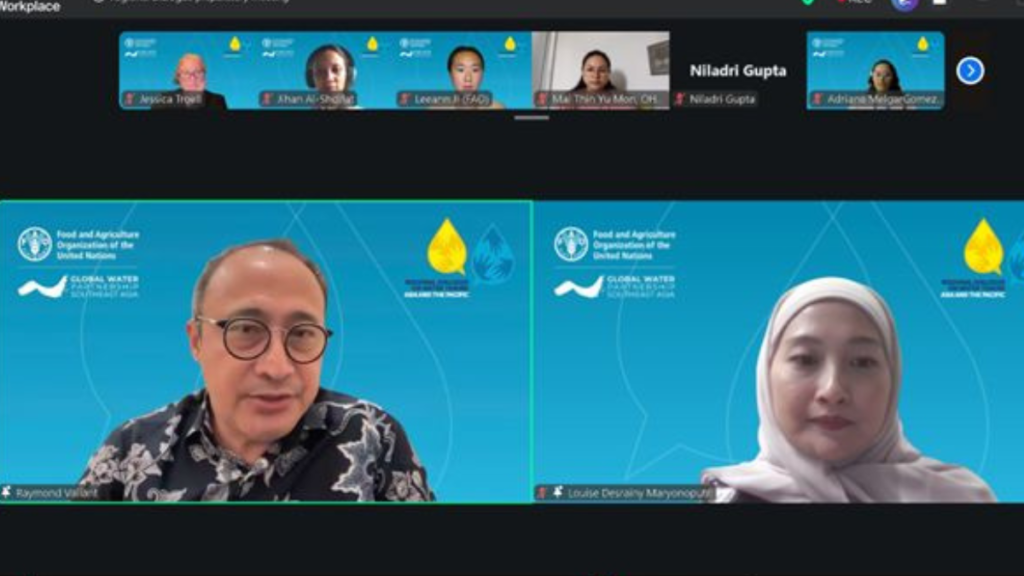
The Pre-Regional Multi-Stakeholder Consultation was held online on 23 April 2026 as a preparatory session for the upcoming Regional Dialogue on Water Tenure for Asia and the Pacific. The session was jointly organized by the FAO Regional Office for Asia and the Pacific and Global Water Partnership Southeast Asia, bringing together 32 participants from across the region, including representatives from government, civil society, academia, and regional networks.
The consultation aimed to build a shared understanding of water tenure and its governance, introduce the 12 Elements of the Responsible Governance of Water Tenure in preparation to the Regional Dialogue scheduled for May 2026 in Bangkok. The session also contributes to the broader Global Dialogue on Water Tenure.
The program combined technical presentations with interactive discussions. Opening remarks from FAO, GWP-SEA, and the Office of National Water Resources of Thailand set the stage by emphasizing the importance of inclusive and coordinated water governance. This was followed by a technical overview of water tenure and an expert-led introduction to the 12 Elements, presented as a draft framework for reflection and feedback.
Participants then engaged in four breakout group discussions facilitated by GWP national and regional experts. The discussions provided valuable insights into how water tenure is understood and implemented across different national contexts.
Several common themes emerged across the groups. A key issue is the complexity of water tenure systems, particularly the coexistence of formal legal frameworks and customary practices. Participants highlighted ongoing gaps between policy and practice, especially where customary systems are not fully recognized or are overshadowed by formal laws. This challenge is closely linked to fragmented institutional arrangements and limited coordination among government agencies, pointing to the need for stronger policy coherence and inter-agency collaboration.
Participants also emphasized the importance of better integration across sectors, particularly between water and land governance. Some water uses, such as fisheries, remain insufficiently recognized in existing frameworks. In addition, challenges related to water data, accounting, and trust in information systems were noted, especially in countries with complex geography and competing water demands that extend beyond economic considerations.
Issues of equity, inclusion, and legitimacy were also central to the discussion. Participants called for clearer recognition of customary rights within legal frameworks and more consistent and fair access to water.
Finally, the discussions underscored the need to strengthen resilience and conflict management, including clearer prioritization of water use during periods of scarcity, improved mechanisms for resolving water-related conflicts, and greater attention to extreme events in water governance.
Overall, the consultation helped shift the conversation toward more practical and actionable approaches to water tenure governance. It also highlighted the need to better define rights, responsibilities, and conditions for water access and management. The inputs gathered will directly inform the Regional Dialogue and support the development of more integrated, inclusive, and context-responsive approaches to water governance across Asia and the Pacific.
Participants are encouraged to continue reviewing the 12 Elements and contribute further inputs, including sharing country experiences during the Regional Dialogue.