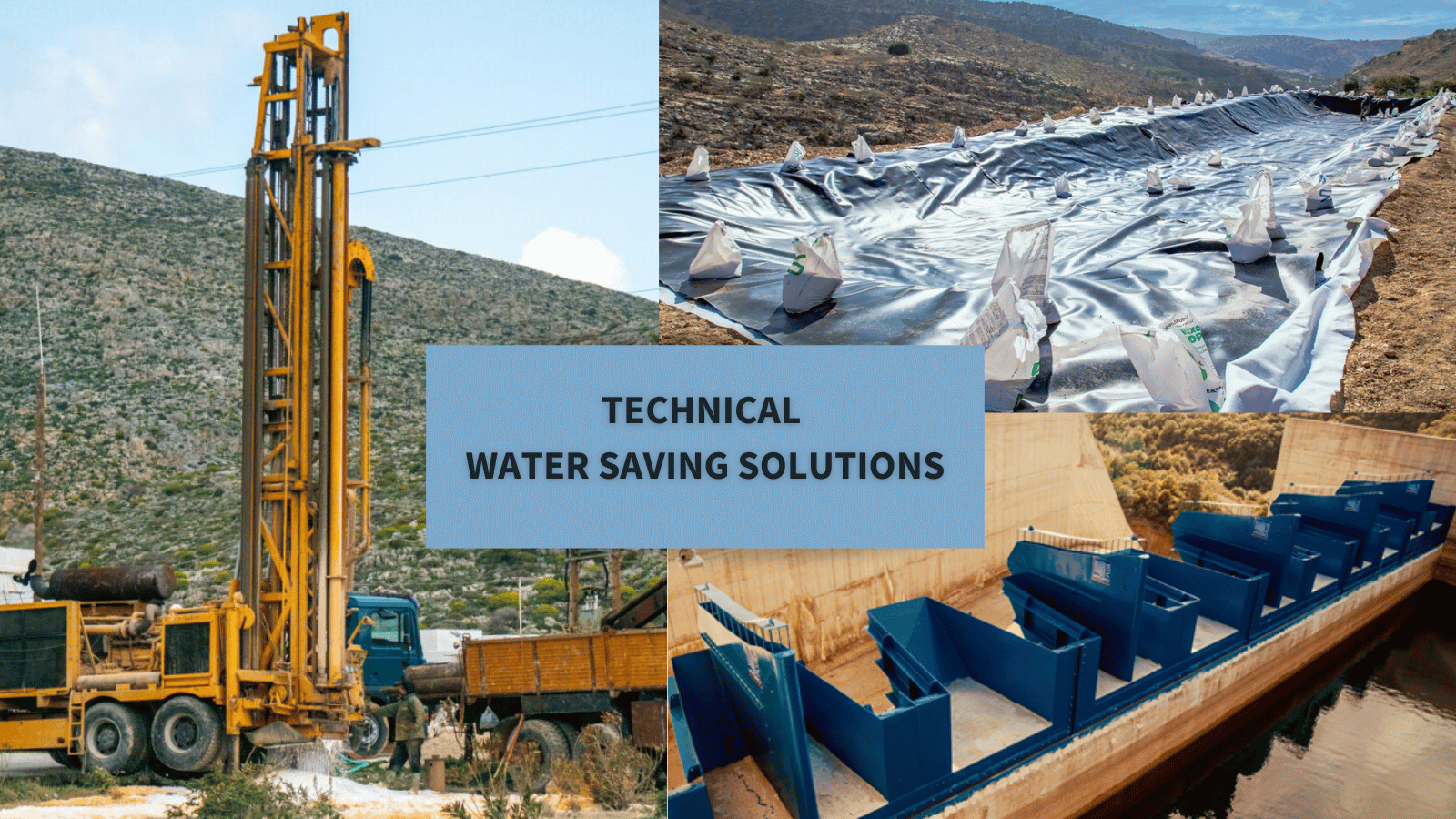
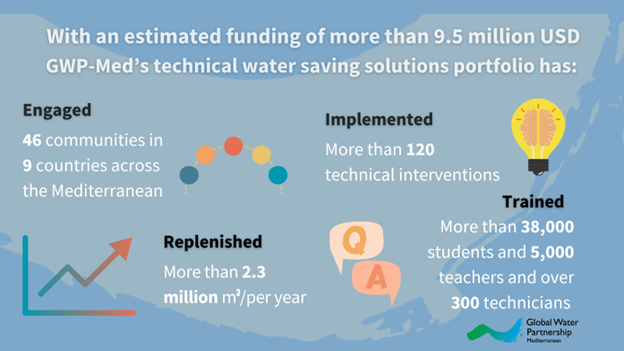
GWP-Med has long experience in implementing corporate water replenishment projects, helping companies like Coca-Cola meet their water replenishment targets through focused interventions. These technical water saving solutions are part of integrated programmes which also engage stakeholders in effective water governance, raise awareness and promote environmental education. Several projects incorporating technical water saving solutions have also been implemented as pilot demonstrations through funding by public donors.
Version française ci-dessous:
Sustainable management of water resources is a key factor for human well-being, food security, healthy ecosystems and economic prosperity. Climate change and biodiversity loss, combined with socio-economic pressures driven by population growth, enhance risks to sustainable supply of natural resources and particularly water. More than 1.7 billion people currently live in communities in river basins that are being depleted by overuse while according to OECD predictions a 40% shortfall in freshwater resources is expected by 2030.
Water management challenges require collaboration, synergies and mobilization of resources. From the corporate sector perspective, water scarcity represents a substantial business risk, also affecting communities where companies operate. In reponse, a number of companies are implementing corporate water replenishment projects, stemming from the need to protect business operations against water scarcity, and a broader commitment to safeguard water resources for society and ecosystems in areas of operation. Collective action can clearly contribute to climate resilient societies and communities’ adaptation to changing conditions.
GWP-Med has been working with private, as well as public, entities for more than 16 years in designing, managing and implementing projects on water efficiency and water replenishment throughout the Mediterranean region, through an IWRM and WEFE Nexus lens. With a portfolio that spans from Southeastern Europe to the Middle East and North Africa region, we are implementing innovative technical solutions in collaboration with local authorities customized to specific local needs.
Corporate water replenishment projects are designed in line with the widely accepted Volumetric Water Benefit Accounting (VWBA) method. This method provides a standardised methodology for assessing the benefits of water stewardship activities, guiding towards impactful activities tha benefit societies and ecosystems, and ensuring that results are accurately estimated.
Implementing customised water solutions together with local communities
GWP-Med has an extensive proven track record in designing, managing and implementing water management / efficiency / replenishment projects, funded directly by the private sector (each ranging between 200,000 and 1,200,000 €), based on clear metrics of quantifiable benefits.
Such projects are composed of a number of action lines, including:
- technical interventions, mostly in public spaces,
- stakeholder engagement and capacity building,
- public awareness campaigns and communications,
- school education, etc.
Technical interventions are implemented in close collaboration with local authorities (e.g. local municipality, water management authorities, etc.), which are often the direct beneficiaries of the interventions. Depending on the type of intervention, these may include Nature-based Solutions, and may be combined with energy, agricultural and environmental efficiency considerations in a Nexus approach, in order to facilitate integrated and efficient management of natural resources.
GWP-Med has a long standing collaboration with The Coca-Cola Company, as the key implementing partner of corporate water replenishment projects in Greece, Malta and Cyprus. The Coca-Cola Foundation has been the main funder of these water replenishment projects, which started in 2008.
Solutions techniques d’économie d’eau
GWP-Med possède une vaste expérience dans la mise en œuvre de projets de réalimentation en eau des entreprises, aidant des sociétés telles que Coca-Cola à atteindre leurs objectifs de réalimentation en eau grâce à des interventions ciblées. Ces solutions techniques d’économie d’eau s’inscrivent dans des programmes intégrés qui engagent également les parties prenantes dans une gouvernance efficace de l’eau, tout en sensibilisant et promouvant l’éducation à l’environnement. Plusieurs projets intégrant des solutions techniques d’économie d’eau ont également été réalisés en tant que démonstrations pilotes grâce au financement de donateurs publics.
La gestion durable des ressources en eau est un facteur clé pour le bien-être humain, la sécurité alimentaire, la santé des écosystèmes et la prospérité économique. Le changement climatique et la perte de biodiversité, combinés aux pressions socio-économiques dues à la croissance démographique, augmentent les risques pour l’approvisionnement durable en ressources naturelles, en particulier en eau. Actuellement, plus de 1,7 milliard de personnes vivent dans des communautés situées dans des bassins fluviaux qui s’épuisent en raison d’une surexploitation, tandis que, selon les prévisions de l’OCDE, un déficit de 40 % en ressources en eau douce est attendu d’ici 2030.
Les défis liés à la gestion de l’eau nécessitent une collaboration, des synergies et une mobilisation des ressources. Du point de vue du secteur privé, la rareté del’eau représente un risque commercial important, qui affecte également les communautés où les entreprises opèrent. En réponse, un certain nombre d’entreprises mettent en œuvre des projets de réapprovisionnement en eau, issus de la nécessité de protéger leurs activités commerciales contre la pénurie d’eau et d’un engagement plus large visant à préserver les ressources en eau pour la société et les écosystèmes dans les zones d’opération. L’action collective peut clairement contribuer à la résilience climatique des sociétés et à l’adaptation des communautés aux conditions changeantes.
Depuis plus de 16 ans, GWP-Med collabore avec des entités privées et publiques pour concevoir, gérer et mettre en œuvre des projets d’efficacité hydrique et de réapprovisionnement en eau à travers la région méditerranéenne, en adoptant une approche GIRE et Nexus WEFE. Avec un portefeuille qui s’étend de l’Europe du Sud-Est à la région du Moyen-Orient et de l’Afrique du Nord, nous mettons en œuvre des solutions techniques innovantes en collaboration avec les autorités locales, adaptées aux besoins locaux spécifiques.
Les projets de réapprovisionnement en eau des entreprises sont conçus conformément à la méthode largement acceptée de la comptabilité volumétrique des bénéfices en eau (Volumetric Water Benefit Accounting – VWBA). Cette méthode fournit une méthodologie standardisée pour évaluer les bénéfices des activités de gestion de l’eau, en orientant vers des activités ayant un impact bénéfique sur les sociétés et les écosystèmes, et en garantissant que les résultats sont estimés avec précision.
Mise en œuvre de solutions personnalisées pour l’eau en collaboration avec les communautés locales
GWP-Med a fait ses preuves dans la conception, la gestion et la mise en œuvre de projets de gestion, d’efficacité et de réapprovisionnement de l’eau, financés directement par le secteur privé (chacun d’un montant compris entre 200 000 et 1 200 000 €), sur la base d’indicateurs clairs de bénéfices quantifiables.
Ces projets sont composés d’un certain nombre de lignes d’action, notamment :
- Des interventions techniques, principalement dans les espaces publics
- L’engagement des parties prenantes et le renforcement des capacités,
- Des campagnes de sensibilisation du public et des communications,
- L’éducation scolaire, etc.
Les interventions techniques sont mises en œuvre en étroite collaboration avec les autorités locales (par exemple, la municipalité locale, les autorités chargées de la gestion de l’eau, etc.) qui sont souvent les bénéficiaires directs des interventions. Selon le type d’intervention, celles-ci peuvent inclure des solutions basées sur la nature et être combinées avec des considérations d’efficacité énergétique, agricole et environnementale dans une approche Nexus, afin de faciliter une gestion intégrée et efficace des ressources naturelles.
GWP-Med collabore depuis longtemps avec The Coca-Cola Company, en tant que partenaire clé dans la mise en œuvre des projets de réapprovisionnement en eau des entreprises en Grèce, à Malte et à Chypre. La Fondation Coca-Cola a été le principal bailleur de fonds de ces projets de réapprovisionnement en eau, qui ont débuté en 2008.
List of Projects
- The Zero-Drop Program: Launched in July 2022 in Folegandros, with exclusive funding from The Coca-Cola Foundation and the support of local communities and public authorities, the Zero Drop water resources protection program is implementing water saving technical solutions in areas facing intense water scarcity, while raising awareness and building capacities to better manage and conserve water resources. Since then, the program has also reached Cyprus, Heraklion Crete, Schimatari and Mornos.
- The Alter Aqua Project: Funded by The Coca-Cola Foundation, with contributions by the Energy and Water Agency and GSD Marketing Ltd, the Alter Aqua project has been promoting the use of Non-Conventional Water Resources (NCWR) since 2011 in Malta.
- The Alter Aqua RECAP Project: Funded by The Coca Cola Foundation, GWP-Med together with Malta’s Energy and Water Agency (EWA)are collaborating in advancing Malta’s water resilience through promoting the use of recycled greywater for domestic uses. The project aims to gain practical experience that will help remove obstacles to upscaling greywater recycling and reuse, and inform relevant enabling policies in Malta’s 4th River Basin Management Plan, which is currently under development.
- The Resilient Thessaly Project: This flood control project, was designed by GWP-Med with support from The Coca-Cola Foundation, in close collaboration with the Municipality of Trikala, Greece and the Municipal Water Supply and Sewage Company of Trikala (DEYAT). The project involved the installation of a rainwater drainage pipeline from the Barra area in Trikala, one of the most flood-prone and densely populated areas of the city. This intervention will act as a protective shield against possible future extreme weather events, providing a solution to the chronic flooding problem facing the area.
- The “Water is in our Hands” project was implemented by GWP-Med and Reckitt’s Finish. It provided concrete tools to combat water scarcity and save water at home. In previous years, Water is in our hands visited Agios Efstratios, Oinousses and Psara, small islands in the Aegean sea also facing the intense challenge of water scarcity. In 2023 the Program visited the island of Lipsi and Tilos.
- The Aigio Water Replenishment Project focuses on minimizing the water leaks of the urban water distribution network of the Aigialeia Municipality, in collaboration with the respective Water Utility, by building on global and Mediterranean best practices and responding to national priorities and local operational plans. It is implemented by Global Water Partnership-Mediterranean, in collaboration with the Municipal Company for Water and Sewerage of Aigio Municipality, and funded by Coca Cola HBC.
- The RESWATER project “Non-Conventional Water Resources for Resilient Urban Water Management in the Mediterranean”, is co-funded by the European Union under the Interreg NEXT MED Programme. Its overall objective is to strengthen water security and resilience in Mediterranean cities by identifying, testing, and promoting non-conventional water resources (NCWR) solutions that address urban water scarcity. GWP-Med is leading the establishment of Living Labs and Community of Practice.
- The Prima NUSTALGIC project aims to valorise climate-resilient neglected and underutilized species (NUS), revive traditional water harvesting systems, foster fair employment and sustainable agri-food systems and create local Innovation Platforms (DRIPS) to co-develop solutions with communities. GWP-Med is leading the Work Package on Water Harvesting and Efficiency whereby we will be implementing six rainwater harvesting technologies in Tunisia, Lebanon, Morocco, Jordan and Portugal.