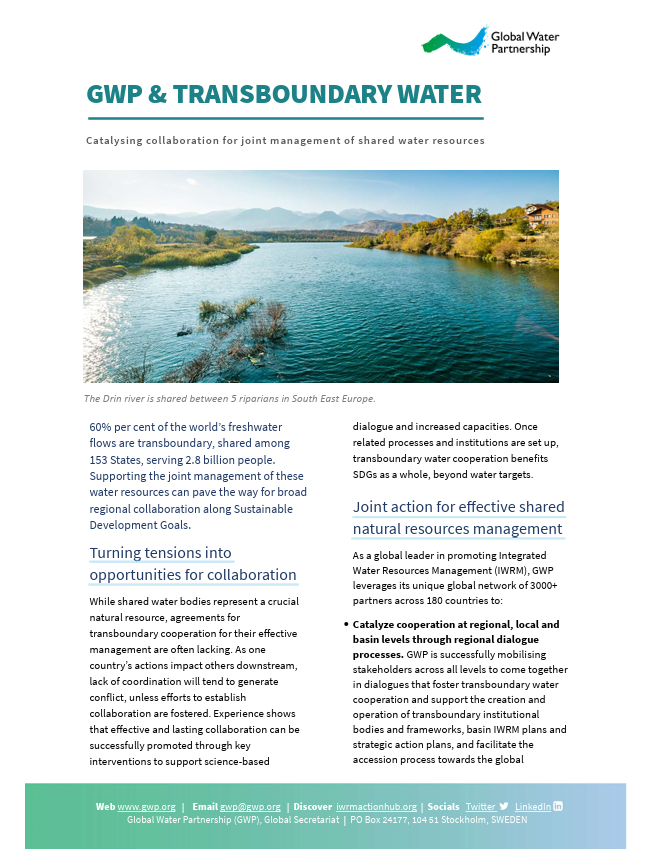
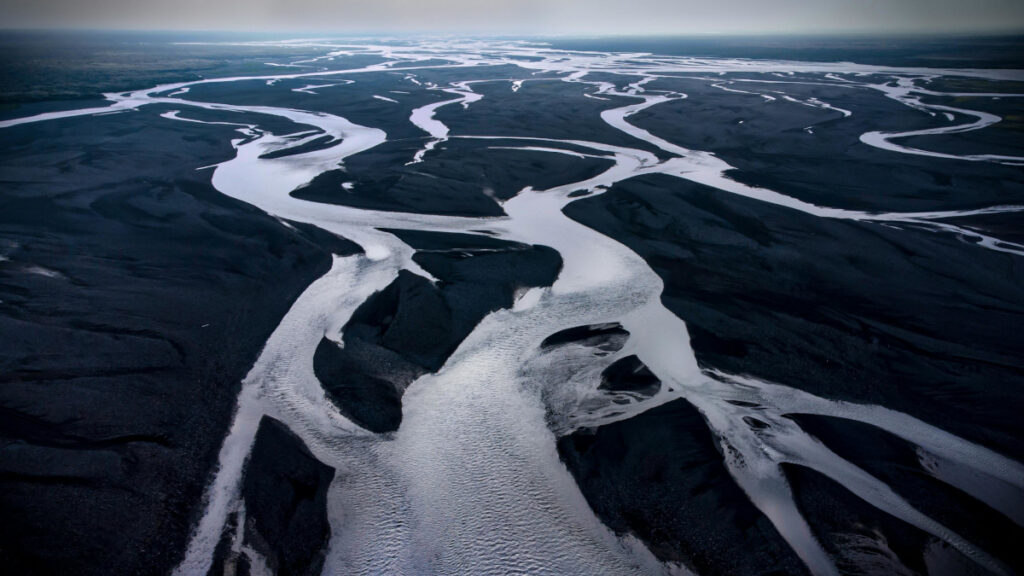
Transboundary basins account for roughly 60 percent of global freshwater resources. Of 192 countries, 153 share 310 rivers and lakes, and 592 aquifers. These water resources serve 2.8 billion people, or 42 percent of the global population. As climate change intensifies water-related risks, stronger transboundary cooperation is increasingly essential to build resilience, strengthen regional stability, and support sustainable development.
Why does GWP work on Transboundary Water?
Transboundary water cooperation/management is critical to GWP’s mission to advance governance and management of water resources for sustainable and equitable development.
Under the GWP Strategy 2026–2030, GWP is accelerating regional, transboundary, and national investment programmes and project pipelines to advance climate-resilient water security. Through its transboundary cooperation work, GWP supports countries and regional institutions to strengthen collaboration across shared rivers, lakes, and aquifers, helping translate cooperation into coordinated action, long-term resilience, and sustainable water management.
As water bodies cross over different political jurisdictions, it is challenging to identify commonly accepted solutions to satisfy competing uses. Cooperation over these shared waters is therefore critical to addressing climate and water security challenges, supporting livelihoods, protecting ecosystems, and promoting sustainable development.
Integrated Water Resources Management (IWRM) can be a useful instrument to fostering this cooperation. Using its strength as a network of a wide range of stakeholders, and being a knowledge partner in the field, GWP is uniquely positioned play a role as facilitator and promoter of sustainable transboundary water management.
What does GWP do?
GWP works with governments, regional organisations, river basin organisations, and partners to strengthen transboundary cooperation through dialogue, governance support, technical assistance, knowledge sharing, and capacity development.
Enhancing cooperation at regional, local, basin, and aquifer levels
GWP works at various governance levels for improved transboundary water cooperation.
Through support to River Basin Organisations, Regional Economic Communities, International Legal Instruments (e.g., 1997 UN Water Convention, 1992 UNECE Water Convention) and other cross-border institutions, GWP promotes transboundary cooperation in Africa, Latin America, the Mediterranean, and Central and Eastern Europe.
This work includes facilitating water dialogues and management practices, establishment of transboundary water commissions, institutional mechanisms, climate adaptation, nexus assessment, basin IWRM plans and strategic action plans, public participation plans, stakeholder engagement plans and information management and exchange.
Facilitating regional dialogues
In contrast to dialogues around specific water bodies, regional dialogues can facilitate more open discussions on key aspects and issues related to transboundary waters. By focusing on solutions, these dialogues can assist in identifying entry points for cooperation. Regional dialogues constitute a series of events (conferences, workshops, study visits, seminars) focusing on policy and technical instruments to address transboundary water management, assisting in highlighting the benefits of cooperation, and leading to improved capacity for practitioners and stakeholders. Such dialogues can be built onto GWP’s existing work with regional economic commissions and institutions. Examples of such regional activities include the following:
- In GWP Mediterranean, regional dialogue on waters has enabled numerous basin-level interventions, including: Memorandum of Understanding (MoU) establishment and implementation (Drin Basin); nexus assessments (NWSAS, Drin and Drin Basins); enhancement of cooperation (NWSAS) and public participation plans (Sava River Basin).
- GWP West Africa has started a regional dialogue on transboundary aquifers with the Economic Community of Western African States (ECOWAS).
- GWP Central America has initiated a regional dialogue on transboundary water with the Central America Commission for Environment and Development.
Capacity building and south-south learning for better transboundary water governance
GWP conducts regional capacity building for practitioners of transboundary water management in Africa, Latin America, and Asia. Key topics include: international water law and governance, water diplomacy, negotiation, and gender mainstreaming. A post-training survey showed 92% of the trainees from Latin America applied knowledge acquired from the programme in their work. Examples of policy influence by African trainees include their contributions to the development of the Volta Basin Charter, IGAD’s regional water resources use protocol, and Chad’s accession to the UNECE Water Convention.
Sustainable Development Goal (SDG) 6:
SDG 6.5 is particularly relevant for transboundary water governance, as indicator 6.5.1 focuses on the degree of IWRM implementation at all levels, including the transboundary level and 6.5.2 focuses on the proportion of transboundary basin area with an operational arrangement for water cooperation. Through GWP’s SDG 6 IWRM Support Programme, GWP facilitates a multi-stakeholder approach to SDG planning and monitoring.
Healthy Rivers, Healthy Ocean Programme
The health of rivers and oceans is deeply interconnected, yet freshwater and marine management are often addressed separately. This disconnect has led to fragmented policies, limited investment, and management challenges such as pollution, altered sediment flows, habitat fragmentation, and declining ecosystem health. It also represents a missed opportunity to jointly advance SDG 6 (Clean Water and Sanitation) and SDG 14 (Life Below Water).
The Healthy Rivers, Healthy Ocean (HRHO) Programme aims to strengthen source-to-sea action by connecting freshwater and marine systems to improve natural resources management at regional, national, and sub-national levels. The programme supports implementation of the Action Platform for Source-to-Sea Management Strategy 2021–2025 and contributes to the New Ocean Action Agenda, particularly efforts to reduce ocean pollution. HRHO has also been endorsed under the United Nations Decade of Ocean Science for Sustainable Development (2021–2030).
What is a source-to-sea system?
A source-to-sea System includes:
- River basins and tributaries
- Connected Aquifers
- Deltas, estuaries, coastal zones and near-shore waters
- Marine ecosystems, including continental shelves and the open ocean
These systems also encompass the ecosystems and socio-economic activities linked across the land-freshwater-marine continuum.
Programme Components
The HRHO programme addresses challenges and gaps at the science-policy-management interface through three main components:
- Component 1: Brokering innovation to strengthen partnerships and environmental monitoring
- Component 2: Enabling source-to-sea action across GWP’s 13 regions
- Component 3: Addressing pollution pressures in selected source-to-sea systems
Through these components, HRHO promotes innovation, coordinated action, improved governance, and sustainable management of source-to-sea ecosystems.
Partners
Core partnersleading the programme are the Global Water Partnership (GWP) the Stockholm International Water Institute (SIWI) and the UNESCO Intergovernmental Oceanographic Commission (IOC).