After years of dialogue and political effort, a Strategy to tackle the Mediterranean’s most pressing resource challenges in an integrated and coordinated way across sectors and borders has been agreed, and a process for its operationalization has been launched.

The “Strategy for the WEFE Nexus in the Mediterranean Source-to-Sea continuum ”, prepared by Global Water Partnership-Mediterranean (GWP-Med), in coordination with UNEP/MAP-Barcelona Convention, the Union for the Mediterranean, the EC DG NEAR, the WES-BCA Project, and the PRIMA Partnership, building on work initiated under the Global Environment Facility-funded MedProgramme, provides a comprehensive framework to strengthen policy coherence across water, energy, food, and ecosystems (WEFE) sectors while unlocking investment opportunities for sustainability and climate resilience. It enables the mainstreaming of systems thinking and supports integrated governance structures across levels.
Sustained consultations across regional political processes on the draft Strategy translated into landmark endorsements in 2025. Its adoption by the UfM Regional Platform on Water and the Barcelona Convention’s Conference of the Parties and the subsequent drafting of the Nicosia Accord, which assists the Strategy’s implementation, highlights the high-level political commitment in implementing concrete, financed action to address climate change, pollution, and water scarcity.
The Mediterranean is one of the world’s most climate-vulnerable regions, where water, energy, food, and ecosystems, the foundations of human well-being, are under increasing pressure. The WEFE Nexus approach enables coordinated action across sectors, helping assess trade-offs, identify synergies, and promote solutions that maximize resource security while respecting the “no harm principle.”
At the same time, the Source-to-Sea (S2S) perspective—linking land, watersheds, aquifers, wetlands, coasts, and marine ecosystems—highlights the interconnected flows of water, sediment, biodiversity, and human activity. The Strategy integrates both dimensions, providing a framework suited to the region’s complexity.
Within this framework, the Strategy offers a framework for integrating policy and management instruments across sectors and spatial components, increasing the capacity to minimize risks and maximize benefits for human livelihoods and socio-economic development across the Mediterranean Source-to-Sea continuum.
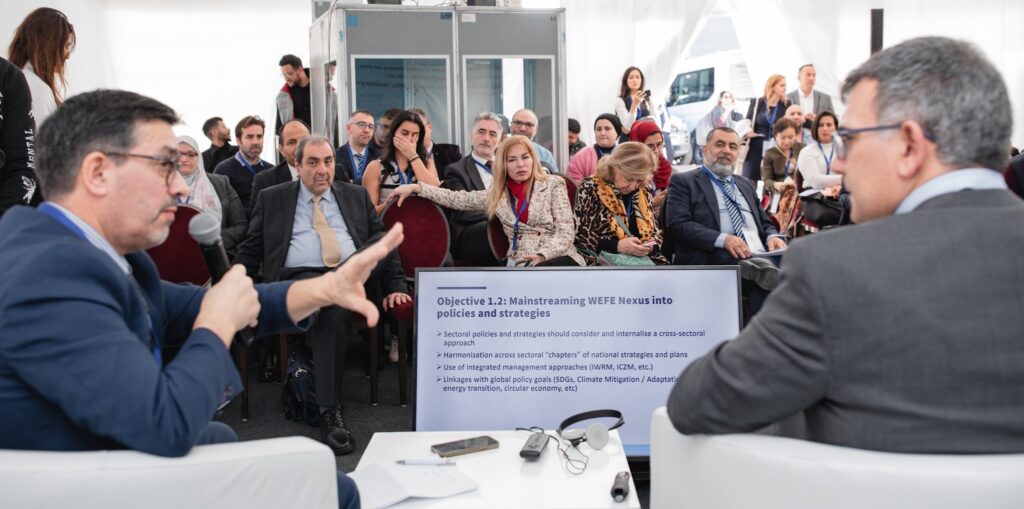
It is structured around 3 Goals and 8 Objectives.
- Goal 1 supports the establishment of appropriate institutional arrangements, policies, and cooperation frameworks at country and regional levels.
- Goal 2 addresses efficient and effective planning, financing and implementation of management and technical solutions.
- Goal 3 promotes informed decision making based on enhanced science-based knowledge, engagement of capacitated stakeholders, and increased public awareness
Together, they reflect a vision where leadership, investment, knowledge, and inclusive engagement drive meaningful change.
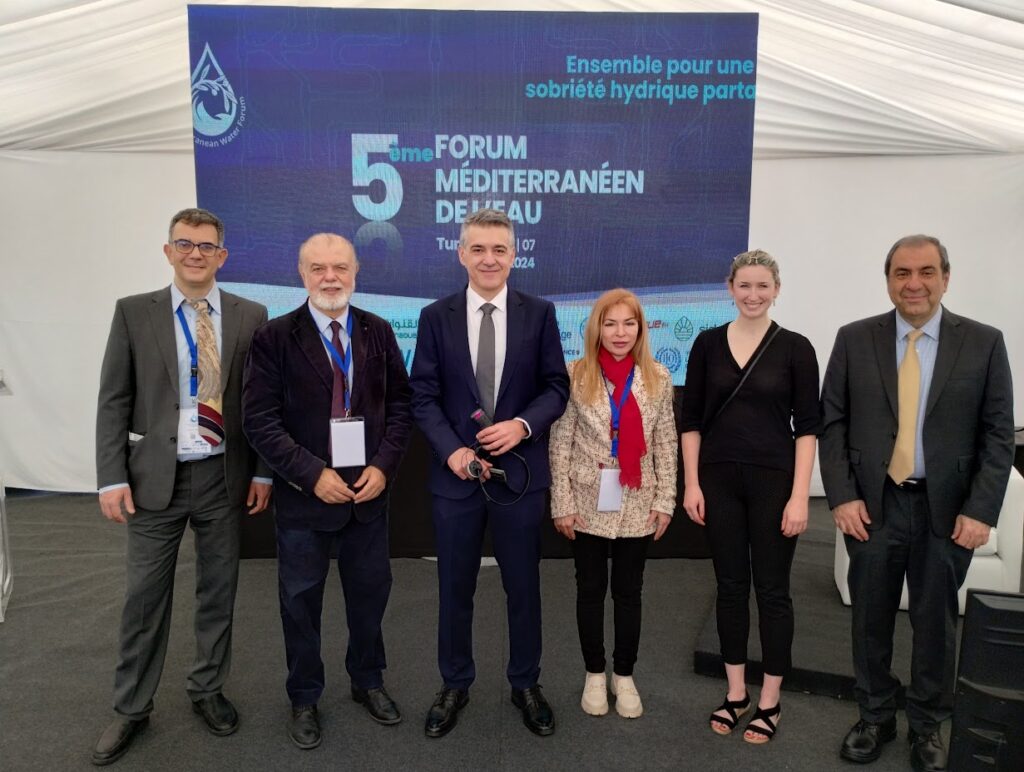
Its development has been the result of a number of formal consultations by national governments over several years. The first consultation took place at the 1st Regional WEFE Nexus Roundtable in the Mediterranean on “Promoting innovation, investments and upscaling solutions” (6-7 June 2023, Rabat), and continued at the 2nd Regional WEFE Nexus Roundtable ‘Towards a Strategy for WEFE Nexus in the Mediterranean Source to Sea continuum’ (5 February 2024, Tunis, in the margins of the 5th Mediterranean Water Forum).
November 2025 marked a turning point, when the 15th Meeting of the UfM Regional Platform on Water in Barcelona formally adopted the Strategy, reflecting the broad political support built over years of dialogue and technical collaboration. This was followed by its adoption as a Flagship Initiative of the Mediterranean Strategy for Sustainable Development (MSSD, 2026–2035) at COP24 of the Barcelona Convention in Cairo (2-5 December 2025)—marking the Convention’s 50th anniversary. Furthermore, The COP’s Ministerial Declaration committed to the implementation of the WEFE Nexus Strategy, sending a strong signal of shared regional resolve toward integrated resource management and climate resilience.
November 2025 marked a turning point, when the 15th Meeting of the UfM Regional Platform on Water in Barcelona formally adopted the Strategy, reflecting the broad political support built over years of dialogue and technical collaboration. This was followed by its adoption as a Flagship Initiative of the Mediterranean Strategy for Sustainable Development (MSSD, 2026–2035) at COP24 of the Barcelona Convention in Cairo (2-5 December 2025)—marking the Convention’s 50th anniversary. Furthermore, the COP’s Ministerial Declaration committed to the implementation of the WEFE Nexus Strategy, sending a strong signal of shared regional resolve toward integrated resource management and climate resilience.
Complementing the broader policy process, targeted regional consultations have further reinforced the Strategy’s relevance and implementation. The dedicated Workshop on Financing for WEFE Nexus Projects, on 8-10 December 2025, contributed to strengthening the financial dimension of the Strategy.
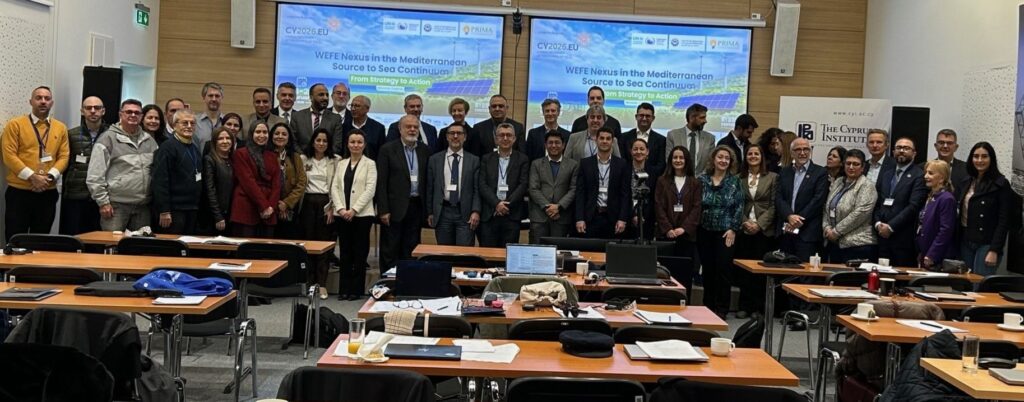
Building on this momentum, the Regional Conference on Water-Energy-Food-Ecosystems Nexus in the Mediterranean Source-to-Sea Continuum: From Strategy to Action, held in Nicosia in February 2026, marked another decisive step in moving from consultation to coordination, and from theory to action. Organised within the framework of Child Project 2.2* of the MedProgramme, the conference, which was facilitated by GWP-Med and the PRIMA WEFE4Med project** and held under the auspices of the Cyprus Presidency of the EU, aimed to translate the Strategy’s ambitions into concrete next steps.
Clear consensus emerged around key operational principles, notably the importance of grounding policy in evidence, empowering stakeholders, and ensuring meaningful citizen engagement. The 3rd Regional Roundtable on Digital Transformation for Advancing WEFE Nexus in the Mediterranean Source-to-Sea Continuum (March 2026) contributed to shaping recommendations for promoting digital transformation in alignment with the WEFE Nexus Strategy and its Action Framework within the frameworks of the Union for the Mediterranean and the Barcelona Convention (UNEP/M
The Mediterranean stands at a critical juncture. Climate pressures and resource challenges demand a new model of cooperation—one that transcends sectors and aligns investments with sustainability goals. The WEFE Nexus Strategy for the Mediterranean Source-to-Sea continuum marks a decisive step toward a more integrated, resilient, and forward-looking approach to managing the region’s critical resources.
* Child Project 2.2 on Mediterranean Coastal Zones: Managing the Water-Energy-Food and Ecosystems Nexus, of the GEF UNEP/MAP MedProgramme led by GWP-Med contributes to the reduction of major transboundary environmental stresses in the Mediterranean region by analysing the trade-offs between WEFE Nexus sectors in beneficiary countries and scaling up successful results. Based on in-depth Nexus Assessments and scientific evidence, the Project aims at providing policy recommendations for the holistic governance and integrated management of natural resources in coastal areas and beyond, adopting a Source-to-Sea analysis.
**The PRIMA WEFE4Med project aims to foster the adoption of a Water-Energy-Food-Ecosystems Nexus approach in the Mediterranean through a Nexus Community of Practice (NCoP) to confront the climatic and environmental challenges facing societies and agro-ecological systems. GWP-Med is the co-coordinator and a consortium partner.