
Place and date: Europe, September 2026
Category: Climate Resilience, Disaster Risk Reduction, Horizon Europe, Knowledge Transfer
Target Group: Water and disaster risk professionals, local and regional authorities, policymakers and researchers
Activity Type: Project Completion, Publication, Knowledge Sharing
After four years of collaboration, the Horizon Europe project The HuT – The Human-Tech Nexus has concluded. Across ten demonstrator areas, partners explored how people, institutions and technology can work together to reduce risks linked to climate extremes, including floods, droughts, heatwaves, wildfires and landslides.
GWP CEE led Work Package 5, which focused on transferability and scalability: how approaches developed in one demonstrator could inform action elsewhere. The work brought partners together through field visits and exchanges, documented their experiences and examined what helps promising disaster risk reduction solutions take root in different settings.
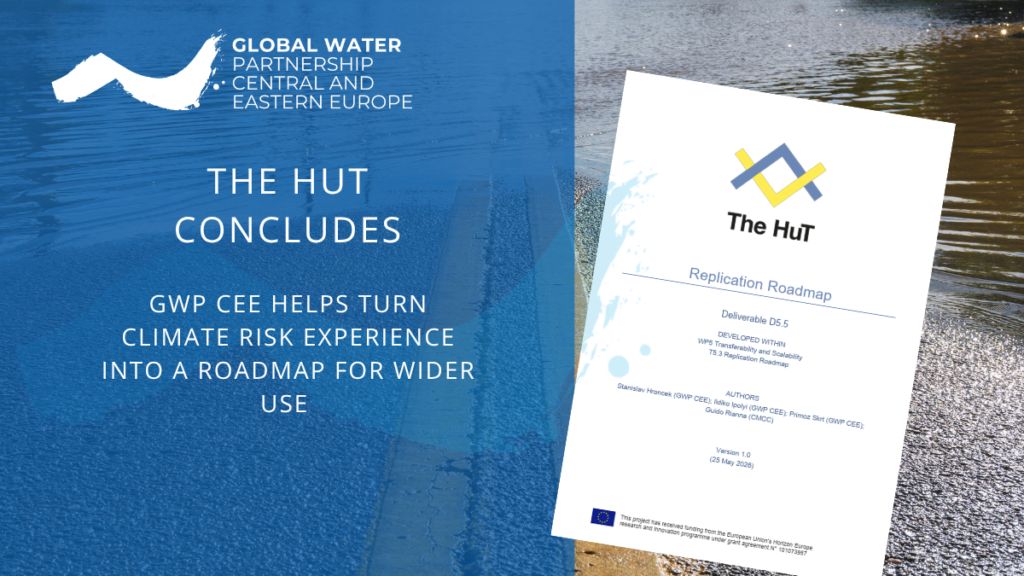
A major outcome is the Replication Roadmap (D5.5), led by GWP CEE and published in 2026. It draws together evidence from across the demonstrators and offers a practical path for taking their lessons further. The roadmap guides readers through identifying transferable elements, adapting them to a new setting, testing them, integrating them into routine practice and exploring wider use.
One of its clearest findings is that transfer requires local adaptation. A monitoring approach or way of engaging communities may be useful in another place, even when the hazards differ. Whether it succeeds depends on the institutions, responsibilities, resources and relationships that support its use.
The HuT’s completion leaves a body of experience for authorities, researchers and practitioners working to strengthen climate resilience. Through WP5, GWP CEE has helped make that experience accessible to people seeking to build on it beyond the project’s original sites.