
Date: September 2026
Place: Europe
Category: Climate Resilience, Disaster Risk Reduction, Horizon Europe, Knowledge Transfer
Target Group: Water and disaster risk professionals, local and regional authorities, policymakers and researchers
Activity Type: Project Completion, Publication, Knowledge Sharing
Slovenia has a solid water management framework, but implementing integrated water resources management (IWRM) in practice remains a challenge. This was the main conclusion of the national workshop on SDG indicator 6.5.1, held at the University of Ljubljana on 15 September 2026. The workshop brought together 35 representatives of state institutions, business, research, municipalities, NGOs and protected areas.
The workshop was part of Slovenia’s fourth 6.5.1 assessment. The Ministry of the Environment and Spatial Planning leads the reporting in close cooperation with GWP Slovenia. Opening the event, Dr Aleš Bizjak of the Ministry thanked GWP Slovenia for its assessments, recommendations and stakeholder engagement.
Slovenia scored 83 out of 100 in 2026, against a national target of 90 by 2030. Participants identified four priorities for improvement:
- simpler, better-harmonised regulations and clearer responsibilities between the state and municipalities;
- earlier, more inclusive stakeholder participation;
- better connected data, especially on groundwater and actual water use;
- stable, multi-year financing, with more investment in prevention and nature-based solutions.
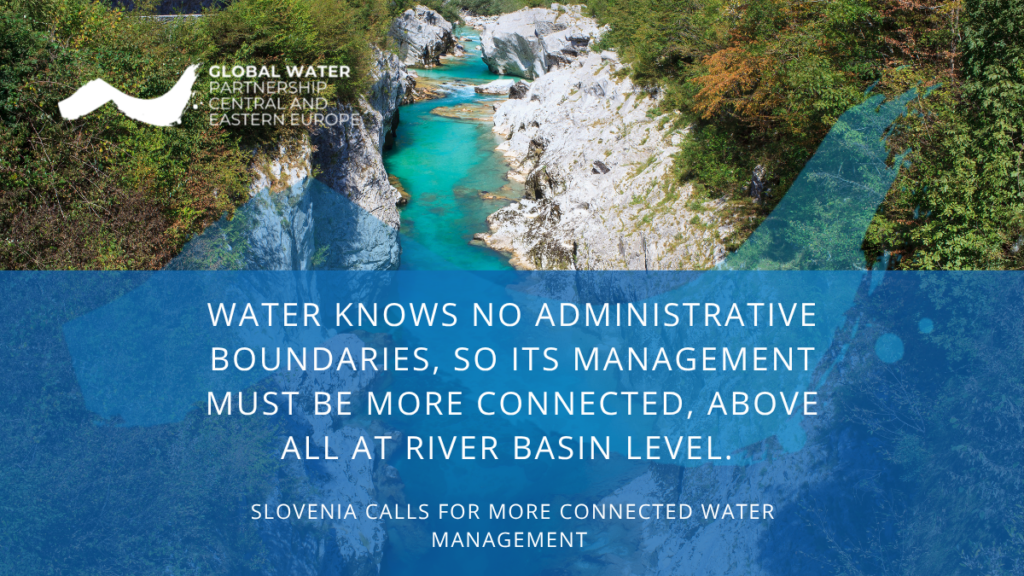
The key message: Water knows no administrative boundaries, so its management must be more connected, above all at river basin level.
The Vipava River Council and the Sava Commission were highlighted as good examples.