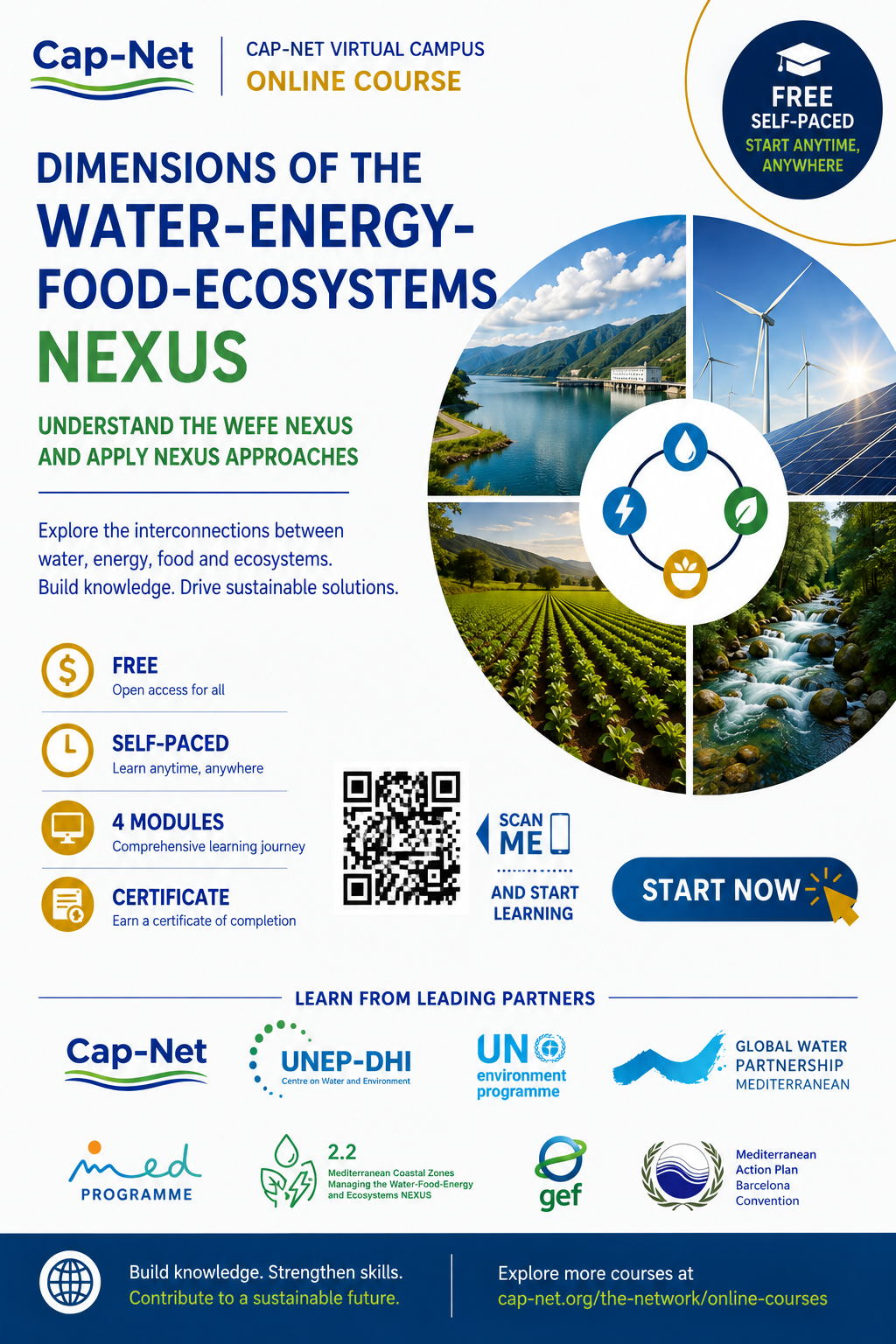
A training course developed to strengthen the capacity of policymakers and experts across the Mediterranean on the Water-Energy-Food-Ecosystems (WEFE) Nexus has now been scaled up into a global learning opportunity through Cap-Net.
Originally developed under the GEF/UNEP-MAP MedProgramme, the course was designed by GWP-Med, implemented through Cap-Net, and supported by the UNEP-DHI Centre, with a focus on the specific challenges and opportunities facing Mediterranean countries. It brought together policymakers and experts from nine MedProgramme beneficiary countries to explore how interconnected water, energy, food and ecosystem challenges can be addressed through more integrated approaches.
From regional experience to global learning
The new Global Dimensions of the Water-Energy-Food-Ecosystems Nexus course builds on the foundations of the Mediterranean training while opening the learning experience to a much wider international audience.
The global course retains the core objective of moving from understanding interlinkages to promoting joint solutions, while expanding the geographical scope of its examples, case studies and learning materials. Experiences from Africa, Asia, Europe, Latin America, the Middle East and Small Island Developing States illustrate how WEFE Nexus challenges differ across contexts, while also revealing common challenges and opportunities.
This evolution demonstrates the value of regional initiatives: solutions and knowledge developed in one context can inspire and support action elsewhere.
Why the WEFE Nexus matters beyond the Mediterranean
Across the world, water, energy, food and ecosystems are under increasing pressure from climate change, resource scarcity, population growth and environmental degradation. Yet these systems remain deeply interconnected.
Decisions made in one sector can create consequences — positive or negative — in another. Managing these connections requires breaking down institutional and sectoral silos and creating space for more coordinated decision-making.
The Nexus approach helps identify integrated solutions by addressing interlinkages, synergies and trade-offs, strengthening water, food and energy security and efficiency while minimising risks to water-dependent ecosystems.
The global course introduces participants to Nexus concepts and frameworks, scenario development, indicators and evidence, climate impacts, stakeholder engagement, financing, governance and the operationalisation of Nexus solutions.
A Mediterranean Initiative with Global Relevance
The evolution of the WEFE Nexus training from a Mediterranean initiative into a global learning resource demonstrates the value of sharing regional experience and knowledge across borders.
Building on experience gained through the MedProgramme, the global course brings the WEFE Nexus approach to practitioners worldwide, while recognising that solutions must be adapted to different local realities.
Through the collaboration of GWP-Med, Cap-Net and the UNEP-DHI Centre, regional knowledge is being connected with global perspectives, creating new opportunities for learning and exchange.
From the Mediterranean to the world, a regional capacity-building initiative is contributing to a growing global community working to understand interconnections, address trade-offs and advance more resilient and sustainable solutions.
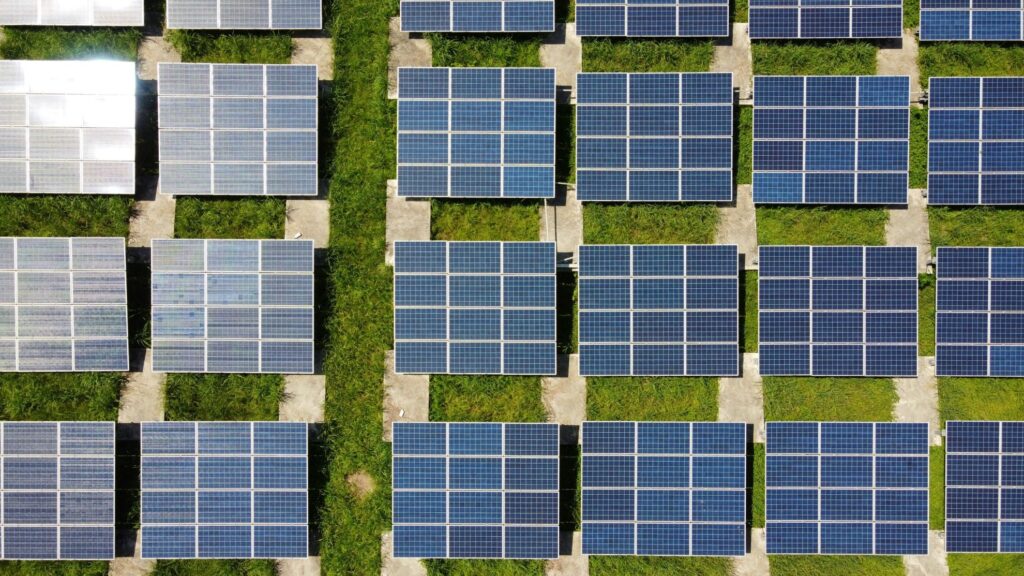
Feature Photo (c) Anders J/Unsplash