
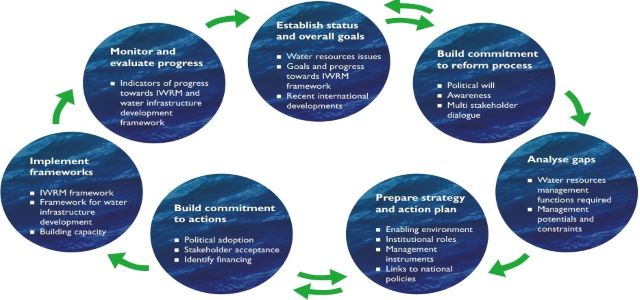
Institutional and policy frameworks supportive of water security and integrated water resource management is still a daunting challenge in Eastern Africa and the Greater Horn of Africa
Water scarcity and climate change will not be adequately addressed in an environment where institutions are not set up, fully functional, and without clearly defined mandates or completely nonexistent.
Some countries in the region are still reflective and calculating the benefits of establishing the ministries, directorates, and departments of water and water resources management and climate change. Issues of capacity gaps in sustainable water resources management may delay the process towards building climate-resilient and water-secure at all levels—local, national, and regional.
Whereas a good number of countries in Eastern Africa and the Greater Horn of Africa have fully functioning institutions with clear mandates, functions, roles, and responsibilities, harmonisation and coordination of water-related policies, strategies, and practices remain an uphill task.
Most water resources in the region—lakes, rivers, and swamps are transboundary, thus managing them equitably and sustainably requires consistent trans-national consultations, high-level diplomatic skills in negotiations and policy dialogue by institutions with such a multi-faceted mandate. This can worsen in situations of actual or perceived conflicts over shared water resources such as the River Nile and Lake Victoria.
Drawing collective understanding and consensus amongst riparian countries and communities on establishing governance and institutional structures for sustainable management of a water resource requires more than knowledge and skills in IWRM and hydrology to more intricate diplomatic details and sensitivities such as specific languages, cultures, gender, lifestyles and existent home-grown water wisdom.
Over the years, GWP Eastern Africa has learnt lessons: establishing institutions for equitable and sustainable management of transboundary water resources requires effective consultations, sensitivities to specific national and local contexts, and flexibility.